The Liberal Democrats could be kingmakers
The Liberal Democrats are projected to win 63 seats, three fewer than in July and nine fewer than in 2024, on 11 per cent of the vote. Compared with 2024, they lose five seats to the Conservatives (Maidenhead, Melksham and Devizes, Mid Dorset and North Poole, North East Hampshire, and Thornbury and Yate), two to Reform UK (Newton Abbot and Torbay) and two to Labour (Hazel Grove and Mid Dunbartonshire).
The Liberal Democrats’ key battleground is with the Conservatives. The Conservatives are second in 43 of the 63 seats the Liberal Democrats win, and in 16 of its 20 most marginal seats.
With Labour 76 seats short of a majority, the Liberal Democrats would be the largest potential partner in any Labour-led government, though together the two parties would still fall 13 seats short.
Restore Britain splits the right
This is the first More in Common MRP to include Restore Britain as a prompted option. The party is projected to win 3 per cent of the vote nationally, and only one seat, Rupert Lowe’s Great Yarmouth.
Even without winning seats, Restore Britain has an effect on the result. In 76 seats where Reform UK finishes second, the gap between Reform and the winning party is smaller than Restore Britain’s vote share. Labour wins 38 of these seats, the Conservatives 27, the SNP eight and the Liberal Democrats three. Of the seats Reform UK was projected to win in July but no longer wins, 54 are seats where it finishes second by a margin smaller than Restore Britain’s vote share.
Not every Restore Britain voter would back Reform UK if Restore were not standing, so these figures show the maximum number of seats where the split on the right could be costing Reform, rather than seats it would definitely win.
SNP leads in Scotland, but Labour are clawing back from their nadir
The SNP holds on as the largest party in Scotland. It is projected to win 27 of Scotland’s 57 seats, three times the nine it won in 2024. But this is down from the 37 seats More in Common’s July MRP projected for the party.
The SNP’s drop since July is driven by Labour’s recovery. The SNP’s vote share only dropped by less than two points. Instead, its losses are driven by Labour winning back support in Scotland. Labour’s vote share in Scotland has risen five points since July, and it takes 14 seats from the SNP, winning 18 in total. That remains only half of the 37 seats Labour won in 2024, but a substantial recovery from the five it was projected to win in July. Reform UK has fallen back in Scotland too, with its vote share down five points and its seat count down from six to one. The Conservatives win six seats, up from three in July and one more than in 2024. They take back three seats in the North East and South of Scotland that Reform UK was projected to win in July.
Reform support slumps in Wales as Labour comes back from the brink
In Wales, Reform UK’s support has collapsed and Labour has come back from the brink. In July, More in Common’s MRP projected Reform UK to win 21 of Wales’ 32 seats, with Labour winning none. Reform now wins just six seats in Wales.
Labour has been the main beneficiary of this drop. Its vote share in Wales is up seven points since July, and it now wins 17 seats – taking 13 from Reform UK and four from Plaid Cymru. That remains below the 27 seats Labour won in 2024, but makes it the largest party in Wales once again.
Plaid Cymru gains two seats since the 2024 General Election, but has fallen from nine seats to six since July – mostly driven by Labour making gains at their expense in South Wales.
Labour’s recovery is concentrated in its traditional heartlands. Around half of the seats it wins are in the south Wales Valleys, including the four Valleys seats that Plaid Cymru was projected to win in July. Most of the rest are in Cardiff and Swansea, with four in north Wales.
Luke Tryl, UK Director at More in Common, said: “On the eve of last year’s Labour Party Conference, our MRP projected Reform could get close to a three figure majority, while both Labour and the Conservatives dropped to below triple figures.
Fast forward to today, and it is clear the electoral landscape has transformed dramatically with Andy Burnham as Prime Minister. Our MRP suggests now that Labour would clearly emerge as the largest party on 250 seats, with Reform UK a distant second on 147 – less than half what they were projected to win this time last year. The Conservatives meanwhile, while still far from being a realistic prospect for Government, have once again made the Battle of the Right competitive, and are only 22 seats behind Reform – whereas they were trailing by 332 seats this time last year
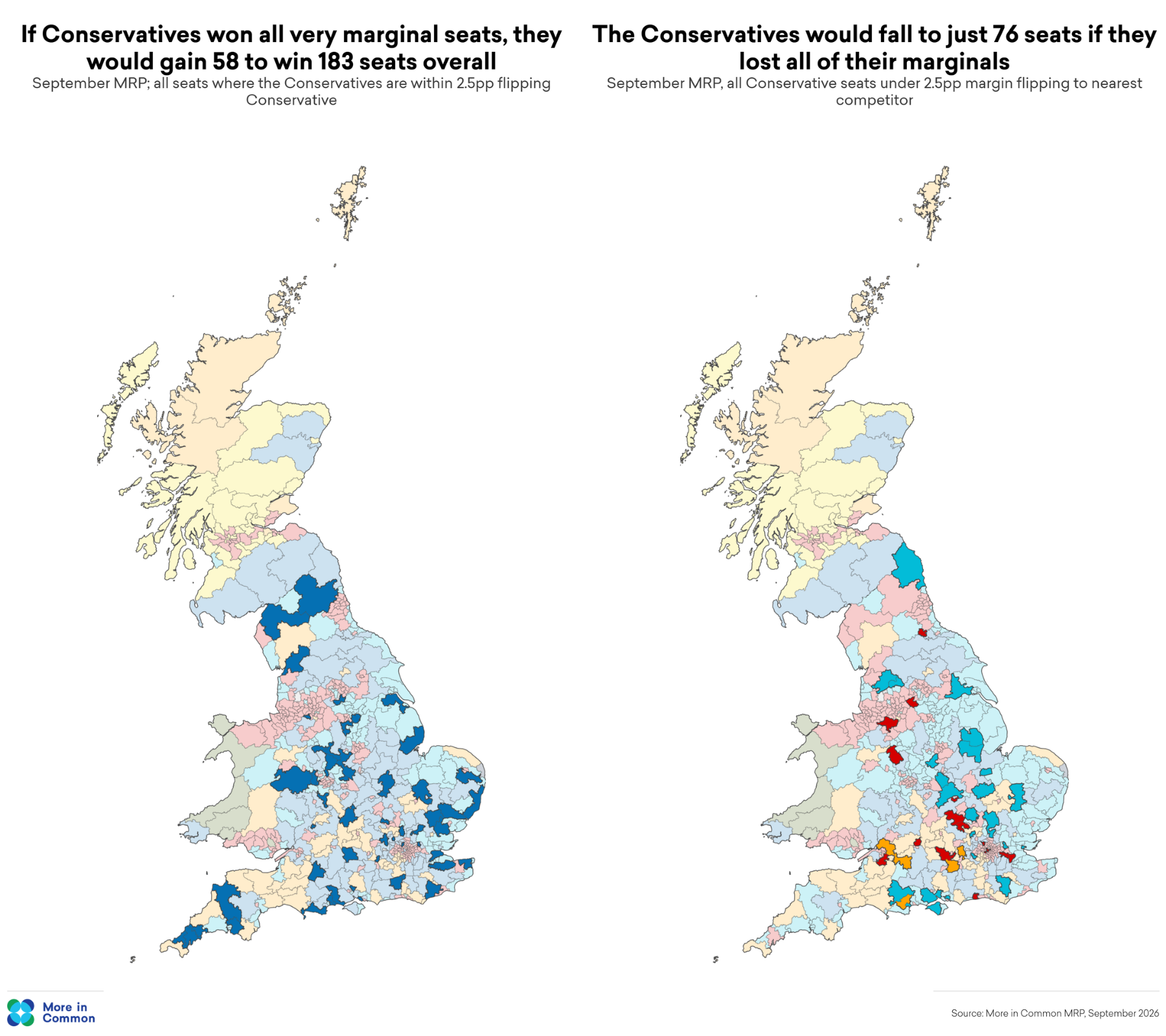
But far from representing a return to politics as normal, volatility has become the new watch word of our electoral system. The model projects that almost half of the seats would be won on margins of less than 5 per cent, meaning small swings in either direction could see any of the Tories, Reform or Labour ending up on top. And while the Labour advantage in seats is comfortable even on these numbers, they would still be forced into a multi-party coalition or arrangement to maintain power.
But the other clear message of these numbers is that tactical voting, of the sort we have already seen play out in by-elections, could have an outsized impact on the numbers – giving a Lib-Lab coalition the numbers for a majority and allowing the Tories to leapfrog Reform. If Reform is to recover to the levels of support it enjoyed last year it needs to find a way not only to build support but also to dampen the level of opposition from its opponents.
As for an Early General Election? On this projection, Burnham’s decision to rule out an early election is a sensible one – while Labour is off its death bed, the party’s recovery is far from complete. To call a poll the Prime Minister would have had to be willing to risk the careers of scores of his colleagues including his Chancellor and Foreign Secretary, while even small shifts in the current numbers would have left him vulnerable to having a stint in Downing Street only longer than that of Liz Truss.”
Methodology
Sample size: 15,765 GB adults
Fieldwork dates: 21 August – 21 September 2026
FAQs
What is an MRP?
‘Multilevel Regression with Post-stratification’ (MRP) uses data from a voting intention poll to model how people will vote based on their demographics, voting behaviour and information about their constituency. These results are then applied to the demographic and electoral makeup of each constituency to make a constituency-level estimate. The model is ‘multilevel’ because it uses both individual and constituency-level data.
How is this different from your normal voting intention poll?
The voting intention regularly published by More in Common is a national estimate based on a representative sample of at least 2,000 people. It indicates roughly how many people in Great Britain intend to vote for one party or another. This is simple to calculate and allows us to track changes through time.
But if you want to estimate a national seat count, this isn’t as useful. No political party performs equally well in every seat, because their supporters are not evenly spread across the country. For example, a 70-year-old man who didn’t go to university and lives in a small village has a higher likelihood of voting Conservative than a 25-year-old woman renting a flat in a major city.
The benefit of MRP is the ability to use information about the different people who live in every constituency across the country to estimate how many people will vote for each party.
How does the model account for those who don’t know how they will vote?
When we ask people their voting intention, some people say they don’t know. We push them to say who they would vote for if they were forced to choose, and we use this response as their expected vote. Some people, when asked to imagine that they were forced to choose, still don’t know who they would vote for. Using our MRP model, we’re able to make a better guess at how these “double don’t knows” might end up voting. When training the model to predict people’s voting intention based on their demographics, voting behaviour and information about their constituency, we excluded the responses of people who didn’t know who they would vote for (after the squeeze) from the training data. When we apply the model to all the voters in the constituency, it effectively means we estimate the votes of people who don’t know, according to how people like them (in terms of demographics and past voting behaviour) but who do know, intend to vote. So if someone lives in a rural area, is over 75 and voted Conservative in 2024, the model uses the fact that most over 75s in rural areas who voted Conservative in 2024 and do know who they’ll vote for say they will vote Conservative, to guess that if they do vote it will likely be for the Conservatives.
Is this a snapshot or a projection?
With three and a half years before the next General Election must be called this model is unlikely to represent anything close to the ultimate result and should not be seen as a projection of the election.
As well as not knowing what might happen between now and 2029, we also don’t know which parties will stand in different seats, what tactical voting might look like exactly and who will ultimately turn out to vote. What’s more, the degree of electoral fragmentation makes individual seat dynamics even more difficult to project than previously.
Instead this model provides a baseline for how the electorate has fragmented since the last General Election and what the implications of that might be for the make up of a future Parliament. We will continue to update it throughout the next Parliament and introduce new data as it becomes available.
Why does the model show X party winning in Y constituency?
MRP models are a good way to estimate how the parties might perform across different constituencies based on their demographic makeup. However, they don’t account for local factors that impact a small number of constituencies, such as a popular incumbent, well known or controversial council policy. These factors make it difficult to predict exact vote shares even in the best of times, but even more so when three parties are polling at over 20%, making three-way races more common. Therefore it would be a mistake to draw too much from the estimated vote share in an individual constituency.