New polling from More in Common on the Drumcree dispute and what it means for Northern Ireland, including our first published Northern Ireland voting intention
New polling from More in Common on the Drumcree dispute and what it means for Northern Ireland, including our first published Northern Ireland voting intention.
For more than a month, Drumcree has dominated politics and public life in Northern Ireland. The dispute raises questions that go well beyond one road or one parade in Portadown: how far Northern Ireland has come, or not come, since 1998, and what identity, culture and respect mean for different communities in the 2020s.
Debates like this need to hear from the widest possible range of voices, not only the people willing to go on air, turn up to a rally or post online. This report sets out what a representative sample of people in Northern Ireland think about Drumcree and what it means for life and politics here.
The poll of 1,019 adults was fielded between 9 and 20 October, in the days after the Secretary of State’s decision to block the parade, and includes More in Common’s first published Northern Ireland voting intention. It is our second study of public opinion in Northern Ireland, following After the Riots, published in July.
Where the public stand on Drumcree
Most think the Secretary of State got it right and the Parades Commission got it wrong. Over half (53 per cent) say the Secretary of State was right to block the parade, and the same share say the Commission was wrong to allow it in the first place. Nationalist and Alliance voters overwhelmingly back the Secretary of State; most unionist voters say he was wrong, though Protestants as a whole are more divided (54 per cent wrong, 28 per cent right).
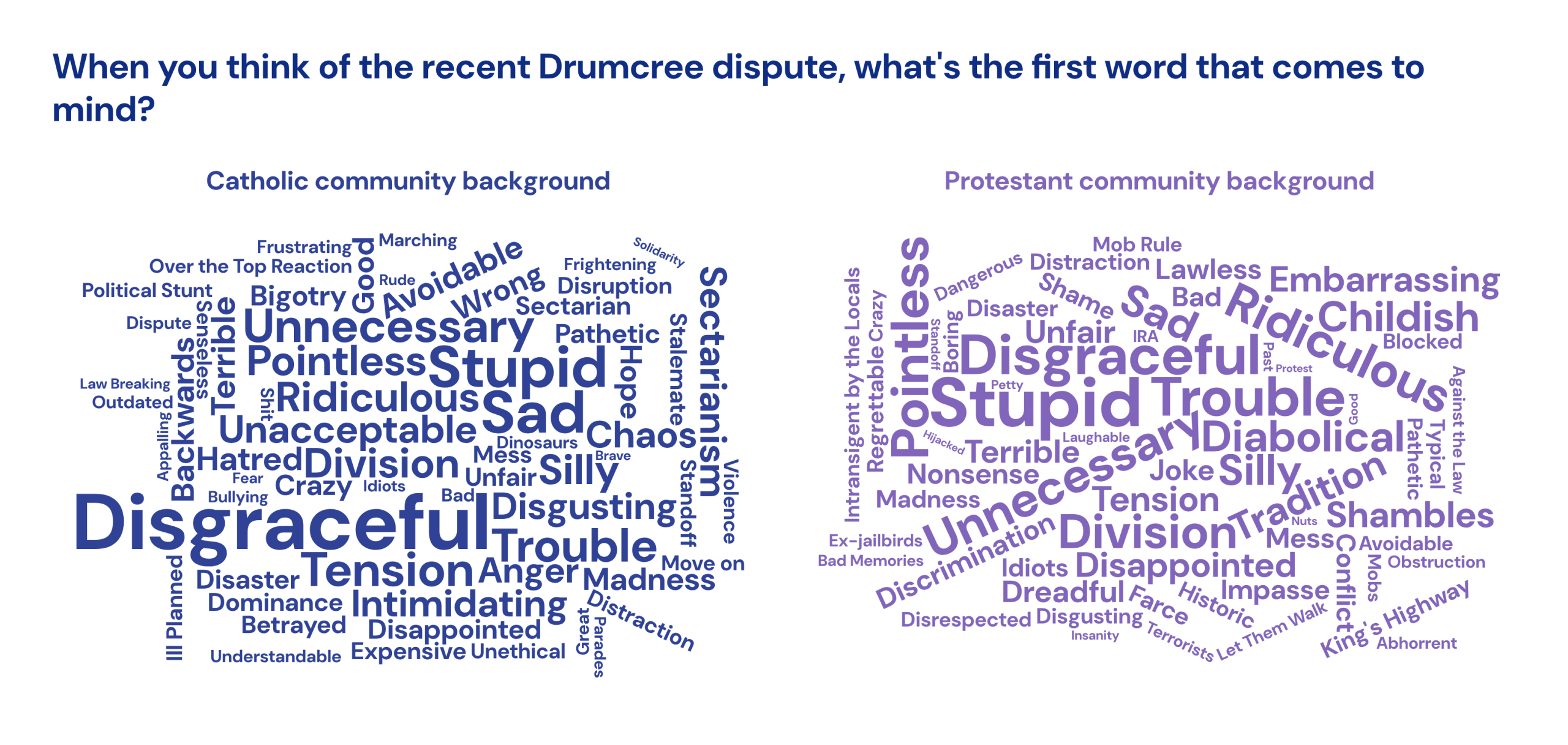
Each community thinks the Parades Commission favours the other side, and only around a quarter of each think it treats both equally.
More sympathise with the Garvaghy Road residents (38 per cent) than the Portadown Orangemen (21 per cent), but two in five don’t pick a side. TUV voters are as supportive of the Orangemen (79 per cent) as Sinn Féin voters are of the residents (81 per cent). Three in five DUP voters (59 per cent) side with the Orangemen, but half of UUP voters don’t pick a side, and among Protestants as a whole more take no side (44 per cent) than back the Orangemen (42 per cent).
Most understand the other side, even if they don’t side with it. Almost three in five Protestants (57 per cent) say they understand why the Garvaghy Road residents feel as they do, and over half of Catholics (51 per cent) say the same of the Orangemen. Almost half (46 per cent) say they understand both.
_
Drumcree is being talked about in families rather than across the divide: 44 per cent have discussed it with older relatives, 15 per cent with friends from a different community background, and only 7 per cent have posted about it online or in group chats.
_
Drumcree is being talked about in families rather than across the divide: 44 per cent have discussed it with older relatives, 15 per cent with friends from a different community background, and only 7 per cent have posted about it online or in group chats.
_
Ending the Drumcree dispute
Avoiding violence matters far more than whether the parade goes ahead. Four in five (82 per cent) say it matters that the dispute ends without violence – twice the share who say the same about the parade not going ahead (41 per cent) and nearly three times the share who say it matters that it does (30 per cent). Two in three voters of every party say avoiding violence matters a great deal. On an issue where gaps between voter groups can run to 60 or 70 points, the gap here is 15.
Of seven ways tested to end the dispute, only one is acceptable to voters of every party: the Lodge’s right to parade is confirmed, but it chooses not to use it. Half (50 per cent) say that would be acceptable, 16 per cent unacceptable, and Catholics and Protestants give the same answer. Every other option is mostly rejected by unionist voters on one side or nationalist and Alliance voters on the other. The partial exception is ‘one and done’ – one final parade, and the Lodge agrees not to apply again. Alliance and UUP voters support it, and Sinn Féin voters oppose it less strongly than they oppose the parade going ahead as the Commission had originally determined, though their opposition is still considerable.
Three in five (60 per cent) want parading arrangements that have kept the peace left alone, even if one side feels they are unfair, and the same share want the Portadown Lodge to accept the decision and not apply again. Nationalist and Alliance voters overwhelmingly want the Lodge to accept the decision; most DUP and TUV voters want it to keep pressing; UUP voters split 47 per cent to 41 per cent in favour of pressing on.
Whoever is marching, most say the organisers should find another route: in mirror-image scenarios of an Orange parade through a nationalist area and a republican parade through a unionist area, at least two in three say the organisers should offer a different route in both cases. Protestants are more likely than Catholics to say a fair outcome means both sides giving ground (58 per cent to 38 per cent), but fewer than one in five people overall (18 per cent) expect the other side to give ground in return.
The politics of Drumcree
In More in Common’s first published Northern Ireland voting intention, Sinn Féin is up from 25 per cent in our July reading to 30 per cent. The DUP is broadly steady on 18 per cent (up one), the UUP on 13 per cent (unchanged) and the TUV on 11 per cent (down one), so together the unionist parties still come to 42 per cent, as they did in July. Alliance has slipped from 11 per cent to 9 per cent and the SDLP holds at 9 per cent. Compared with first preferences at the 2022 Assembly election, the biggest change is the fall in Alliance support from 14 per cent to 9 per cent; the DUP is down three and the UUP and TUV have both gained.
A full account of the methodology, including weighting and the treatment of undecided voters, is available here.
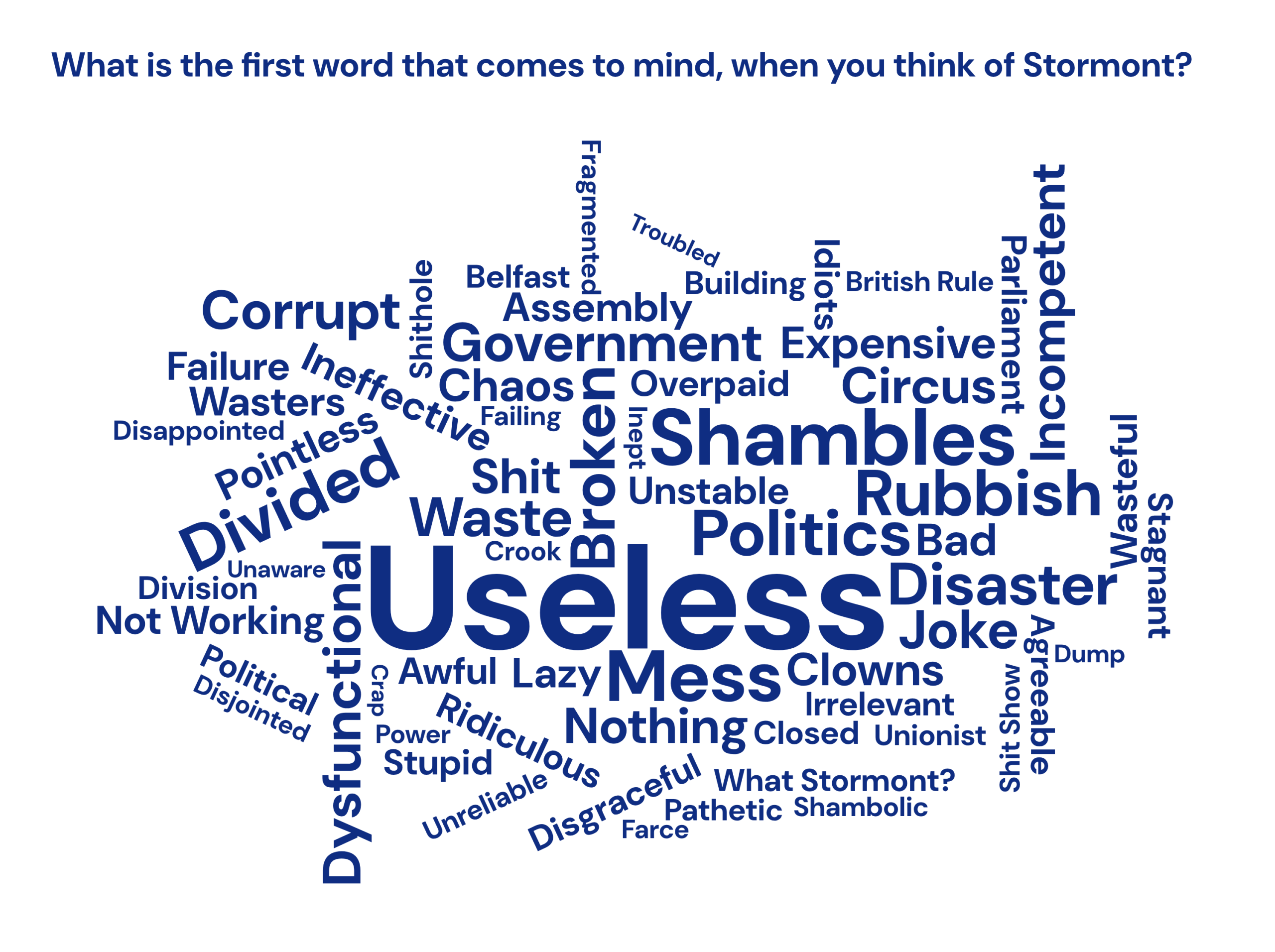
Two in three (64 per cent) say the Assembly and Executive make little or no difference to their own lives; only 6 per cent say a great deal. When asked to describe Stormont in a word, the most common response is ‘useless’.
Half say Drumcree is not a good enough reason to collapse Stormont: 49 per cent say it is not a strong enough reason for any party to pull out of the Executive, and 27 per cent say it is. Nationalist and Alliance voters are firmly against it. Unionist voters are more open, but split: UUP voters lean against (45 to 31 per cent), DUP voters lean in favour (53 to 31 per cent), and TUV voters are the only group where a clear majority (72 per cent) would back a walkout. If the institutions collapsed again, 39 per cent would be concerned and 32 per cent would not.
How Northern Ireland feels after Drumcree
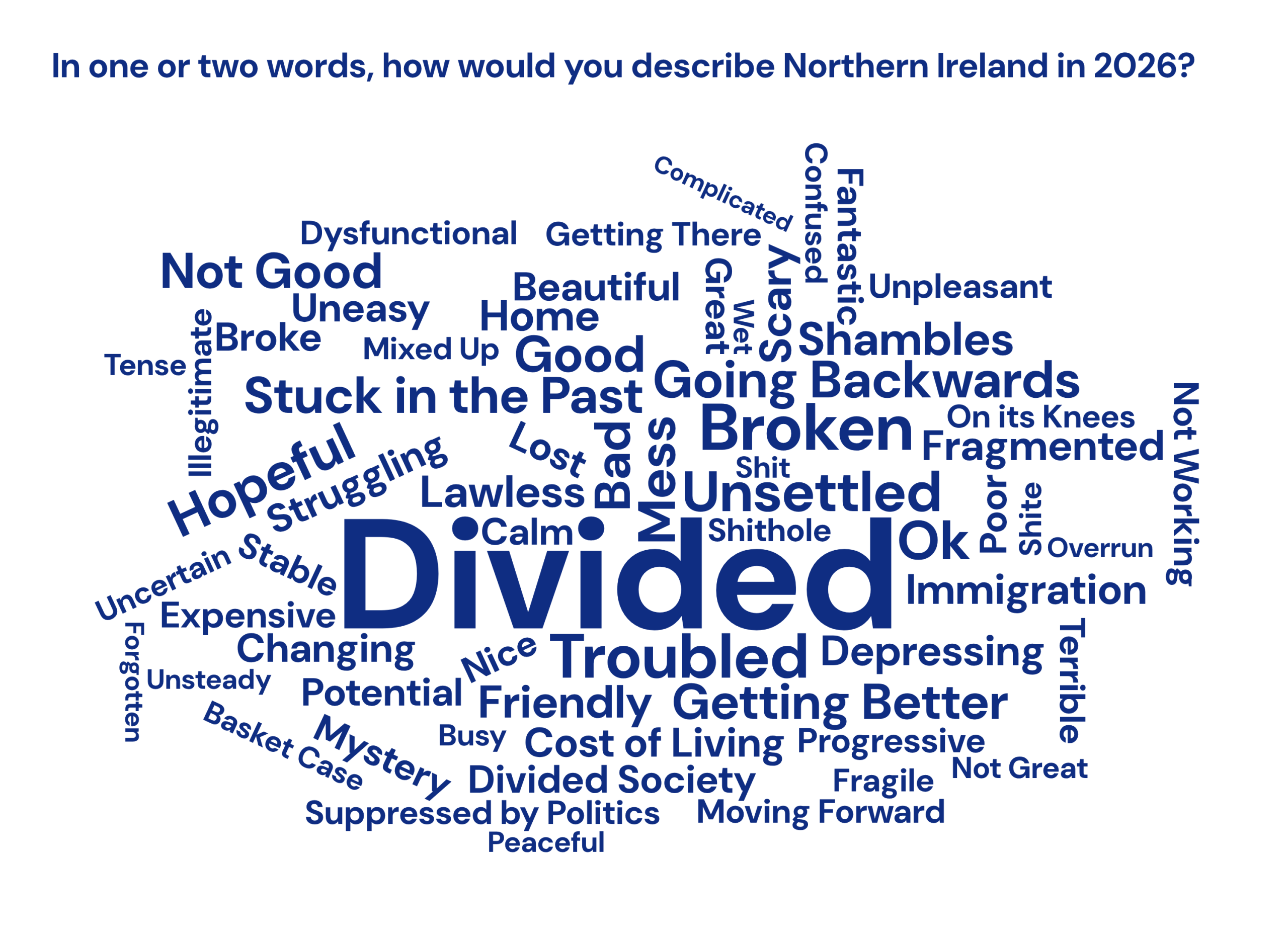
Two thirds (68 per cent) say Northern Ireland is divided, and after Drumcree the public once again see the biggest divide as between unionists and nationalists (50 per cent, up from 35 in June) rather than, as after the riots, between immigrants and people born here. Fewer people feel safe than in June (70 per cent, down from 78), and the steepest fall is in how safe unionists are seen to be.
Each community thinks the law comes down harder on its own side. Asked how confident they are that each side would be held fully accountable for breaking the law during the dispute, each community is confident about its own people and doubtful about the other side’s. Protestants are confident an Orangeman would be held to account (+47 net) and doubt a nationalist politician would be (−52), a gap of 99 points. For Catholics the equivalent gap, between a Garvaghy Road protester (+28) and a unionist politician (−26), is 54 points. Half (50 per cent) back the PSNI’s decision not to remove protesters from the Garvaghy Road, and fewer than half (42 per cent) think the PSNI treats both communities equally, down from 50 per cent in June.
Culture is contested, but there is common ground. Half of Catholics would rather the Twelfth didn’t happen; a quarter of Protestants say the same about the Fleadh. But 72 per cent say the Fleadh was good for Belfast, including 58 per cent of Protestants, and seven in ten welcomed Loyalist and Ulster-Scots bands taking part. Asked what would make them more likely to go to the other side’s events, Catholics and Protestants give the same answers: no paramilitary flags, a clear welcome for all, and knowing it would be safe.
Despite the division, people haven’t given up. Three in five (60 per cent) say Drumcree shows Northern Ireland hasn’t moved on much since the 1990s, but two in three (66 per cent) still lean towards its best years being ahead, up from 60 per cent in June. The rise comes from Catholics (58 to 71 per cent); Protestants are broadly unchanged.
Four perspectives on Drumcree
Three in five people are on one side or the other of Drumcree, but two in five are not. A latent class analysis (LCA), which groups respondents by their answers to 14 questions on Drumcree, finds four perspectives:
The Road (38 per cent) want no parade and side with the residents;
The Hill (22 per cent) think the parade should have gone ahead and side with the Orangemen;
The Bridge (29 per cent) see a case on both sides and would accept almost any ending;
The Bypass (11 per cent) are not following the dispute closely and take no side.
The full profiles are in the report.
“It’s clear that divides on Drumcree are deeply felt across Northern Ireland. Communities disagree sharply on what has happened, who is to blame and what an acceptable resolution to the dispute could look like. But division is only part of the story. Two in five don’t pick a side, and most people say they understand why the other side feels as it does. Asked what matters most in how this ends, people of every party and across communities give the same answer: that it ends without violence. And one ending – the Lodge’s right to parade confirmed, but not used – is acceptable to voters of every party.”
Conleth Burns, Associate Director (Ireland and Northern Ireland)
More in Common will return to these questions as we build out our work in Northern Ireland, with deeper studies on culture and commemoration and on migration in the months ahead, and more detailed electoral analysis in the run-up to the Assembly election.
Subscribe to
our newsletter
Get the latest polling data, insights, and analysis delivered to your inbox.
We’ll never share your details. By signing up you agree to receive communications from More in Common. Read our Privacy Policy.