Healthcare & NHS Labour Party Politics

Where Britain stands on Burnham’s social care levy proposal

Our latest polling looks at public opinion surrounding social care in the UK: how should it be funded, how much should people pay, and is there popular support for the mooted proposal to replace inheritance tax with a social care levy?
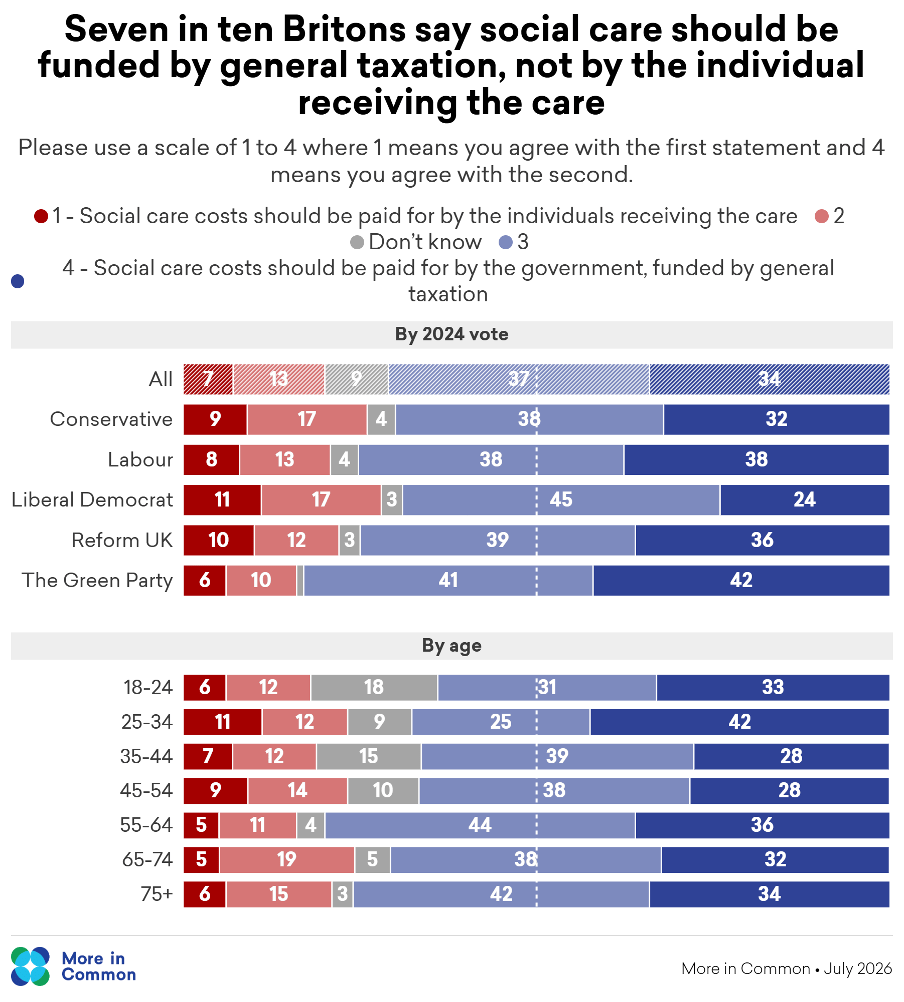
  • Seven in ten (70 per cent) say social care costs should be met by the government through general taxation, compared to only 15 per cent who think it should be paid by the individuals receiving care.
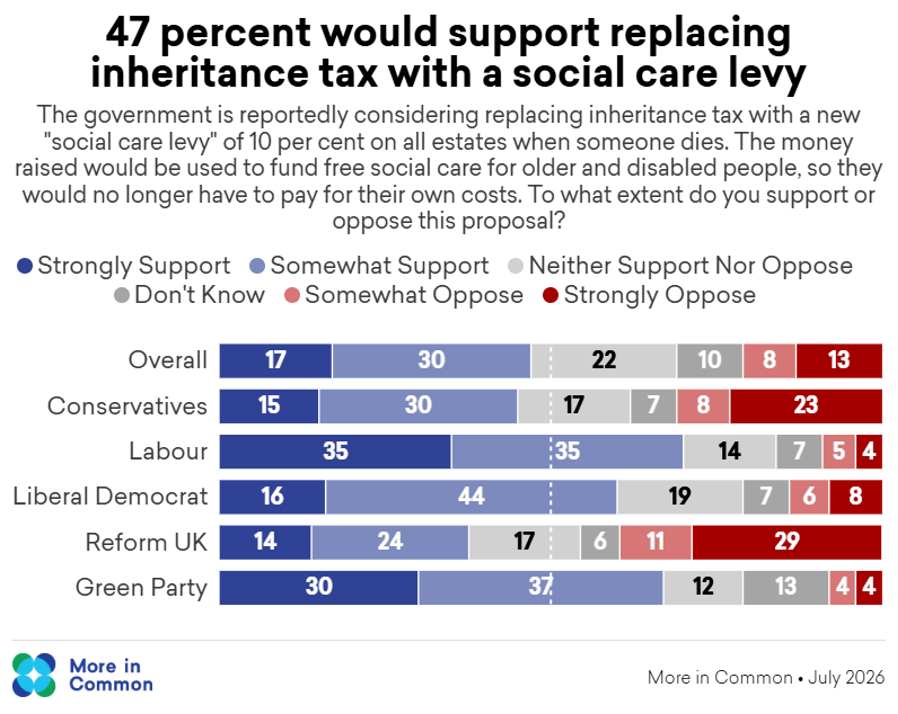
  • 47 per cent support mooted plans for a national care levy to replace inheritance tax in order to fund social care.
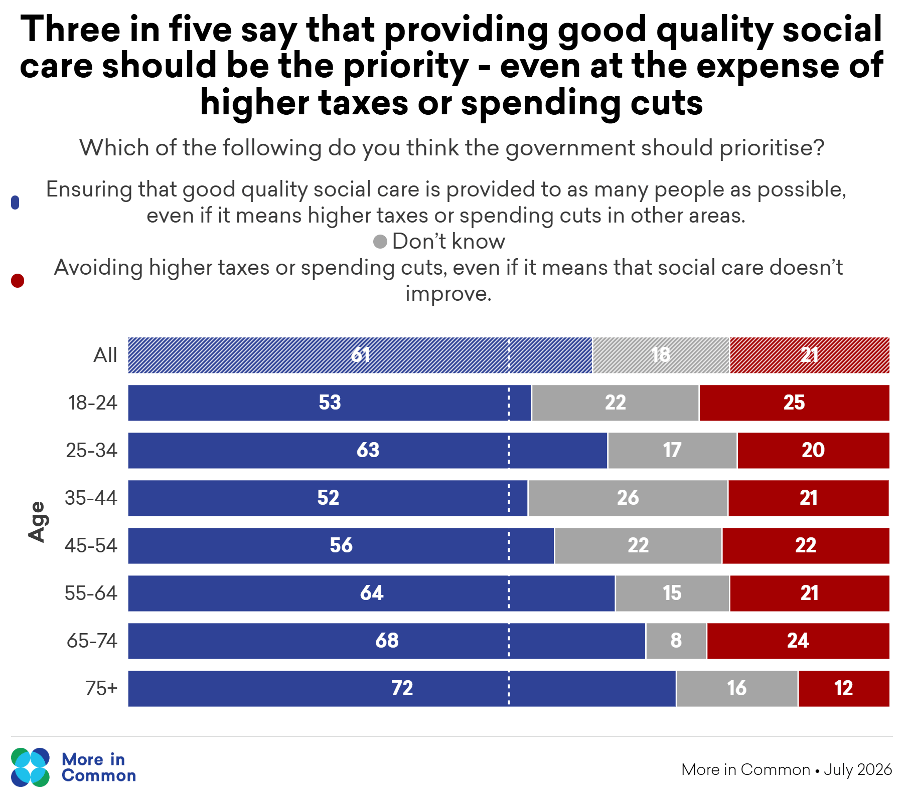
  • Three in five (61 per cent) say the priority should be good quality care for as many people as possible, even if that means higher taxes or spending cuts elsewhere.


Britons think social care should be paid for through general taxation, not by individuals

Seven in ten Britons (70 per cent) say social care costs should be paid for by the government, funded by general taxation, compared with 21 per cent who say they should be paid for by the individuals receiving the care.

This belief holds across every voter group and age group. Support for tax-funded social care is shared across all major parties: 83 per cent of Green voters, 75 per cent of Labour voters, 75 per cent of Reform UK voters, 70 per cent of Conservative voters and 69 per cent of Liberal Democrat voters. 

While the belief is more widely held among older Britons, 64 per cent of 18 to 24 year olds still believe in funding social care through general taxation, rising to 80 per cent of 55 to 64 year olds and 76 per cent of over-75s.

Half of Britons back replacing inheritance tax with a social care levy

Almost half of Britons (47 per cent) support mooted measures to replace inheritance tax with a new 10% social care levy on all estates to fund free social care for older and disabled people. 21 per cent oppose the idea while a further 22 per cent neither support nor oppose.

Support outweighs opposition across every group of 2024 voters except Reform. Labour voters are the most supportive at 70 per cent, followed by Green voters (67 per cent), Liberal Democrat voters (61 per cent) and Conservative voters (45 per cent). Reform UK voters are the least supportive at 38 percent, with 40 percent opposed.

Older Britons tend to support the policy: 49 per cent of 65 to 74 year olds back the social care levy, alongside 41 per cent of over-75s.

Britons want to see social care improved, even at the expense of higher taxes or spending cuts

Three in five Britons (61 per cent) say the government should prioritise ensuring good quality social care is provided to as many people as possible, even if that means higher taxes or spending cuts in other areas. Just 21 per cent say the priority should be avoiding higher taxes or spending cuts, even if social care does not improve.

Older Britons are the most likely to want care prioritised, with 72 per cent of over-75s and 68 per cent of 65 to 74 year olds suggesting that higher taxes are acceptable if that means greater provision of good quality social care.

Labour voters are the most supportive of prioritising care, at 75 per cent, followed by Green voters (71 per cent), Liberal Democrat voters (67 per cent) and Conservative voters (62 per cent). Again, Reform UK voters are the least likely to prioritise care, but still 58 per cent do so, against 29 per cent who would rather avoid tax rises or spending cuts.

Britons think what people pay should depend on what they can afford

Almost three in five Britons (58 per cent) say the amount people pay for social care in old age should be based on wealth, even if that means richer people end up paying more than poorer people for the same service. A quarter (26 per cent) disagree, saying everyone should pay the same amount, even if that means those who are less well off end up with little or nothing to pass on to their children.

Every group of 2024 voters holds the view that people should pay based on what they can afford, from 68 per cent of Green voters and 62 per cent of Labour voters to 51 per cent of Conservative voters and 50 per cent of Reform UK voters.

While Britons tend to support payments based upon wealth regardless of age, those aged 65 to 74 are the most divided, splitting 49 per cent in favour against 43 per cent who say everyone should pay the same. Every other age group backs wealth-based payments by a margin of at least 25 points.

Luke Tryl, UK Director at More in Common, said:

“Britain’s social care crisis has bedevilled successive Governments, while attempts at reform have become associated with electoral peril.

The good news for Andy Burnham’s social care push is that Britons want to see it prioritised and are willing, at least in principle, to have a conversation about the types of tax rises that might be needed to fund social care – and don’t recoil from ideas such as an estates levy.

That said, awareness of different models remains low, and people might be more reluctant to see their own taxes rise in the face of a forceful anti-tax rise campaign. The Prime Minister may have to spend political capital once the shape of the proposals is known to show they are fair.

Succeed, and he will have proved the government can tackle big long-term challenges that affect everyone. Fail and once again social care will end up in the ‘too difficult’ box with a public even further convinced the only way out of Britain’s problems is to abandon the traditional mainstream.”

Subscribe to
our newsletter

Get the latest polling data, insights, and analysis delivered to your inbox.

We’ll never share your details. By signing up you agree to receive communications from More in Common. Read our Privacy Policy.