Who are Dissenting Disruptors?
Dissenting Disruptors make up around 20 per cent of the UK population, and are the core of the populist right today.
Most reject multiculturalism, believe that free speech in Britain is under threat, and feel that Islam is incompatible with British values. Almost all (94 per cent) say that politicians lack respect for people like them, and many feel we need to “burn down” established norms and institutions.
Half of Dissenting Disruptors (51 per cent) believe Britian could face a civil war within the next ten years.
“Bring back Guy Fawkes. I’ll help him.”
- Hannah, retired, Derbyshire
“It’s going to be a breaking point in my opinion.(…) whatever powers that be, they seem to want civil war. (…) I don’t think violence is the way in general at all, but something’s got to change. (…) Do we live in a democracy if no one actually gets what they vote for?”
- Pete, music producer, Manchester
Dissenting Disruptors can be found in every demographic group and in every part of the country. However, they are more likely than others to live in post-industrial towns close to where they grew up, and less likely than others to have attended university.
They are the most financially insecure segment, with only three in ten describing themselves as financially comfortable. Despite skewing older, they are among the least likely to own their own homes, and the most likely to worry about money.
They report the lowest life satisfaction, are the most likely to say that they feel lonely most days, and the least likely to say they feel respected. Two-thirds say they feel disconnected from society, more than any other segment.
In some ways, these experiences of life in Britain shape their attitudes: experience of hardship fuels a sense that the social contract is broken and that the system is rigged; while a sense of disconnection and atomisation drives fears about migration and integration.
“For me, I just think the average person or the average family who go out to work, work hard, earn a decent wage, they’re just forgotten about. We don’t get help with anything. We’re just left to fend for ourselves almost. So people who work really hard have an average job, have an average house just are expected to just struggle on.”
- Sarah, SEND teacher, Wolverhampton
“The problem is it’s all segregated. (…) most people don’t know their neighbours anymore (…) 10 years ago when I was living at my parents’, we knew everyone 10 doors down, both ways and across the road. Now, I think my parents only know the two people that are directly next to them and across the road, and that’s it.”
- Dean, IT manager, Dartford
Dissenting Disruptors believe that Britain’s best years are behind us, and worry about the world that their children will grow up in.
As with most Britons, migration and the cost of living crisis are key issues for Dissenting Disruptors. However, Dissenting Disruptors back more radical measures to address both and have little faith in the political system to deliver.
I just worry all the time about lots of things. I worry about my son, the middle one with the learning disabilities, what will be for him when I’m no longer there to care for him. So yeah, I worry a lot.
- Caroline, nurse, Doncaster
Most Dissenting Disruptors believe multiculturalism has failed and that current levels of immigration pose a threat to the British way of life. However, there is a split within Dissenting Disruptors: some are not inherently opposed to legal immigration in principle, but are concerned that British culture is being diluted and want to ensure that migrants contribute and integrate socially; others are ethno-nationalists who have little faith that a multi-ethnic society could work.
Dissenting Disruptors are economic populists: they believe that taxes on working people are too high, but also worry that Britain is being ripped off by big business and billionaires. They want to see key industries renationalised.
Three quarters (77 per cent) of Dissenting Disruptors believe that Britain no longer has freedom of speech, and many describe feeling unable to express their views openly on topics like immigration. For many, seeing
Dissenting Disruptors are uniquely distrustful of elites and institutions: they overwhelmingly feel as though politicians don’t respect them, and three in five believe that a secret group of powerful elites controls major world events.
On many of these issues, they diverge from other segments on the British right. While they align on some issues like migration, they stand out in their attitudes toward the economy, free speech and Britain’s institutions.
Unlike the populist right in some other countries, Dissenting Disruptors are not outliers on issues relating to sex, gender or sexuality: few want to roll back social progress on gay rights, restrict abortion access, or return to traditional gender roles.
Dissenting Disruptors are not MAGA. In fact, only a third hold a positive view of Donald Trump, and few believe he has been good for the world.
Dissenting Disruptors online
It would be a mistake to conflate the attitudes of some of the loudest voices on social media with the views of the majority of the country – or even of the populist right. Dissenting Disruptors who do spend considerable time online differ from those who don’t.
Around a quarter of Dissenting Disruptors (24 per cent) say they use X most days, and those who are active on X stand out in their tendency to hold more socially conservative views, particularly when it comes to gender roles and figures on the online right.
Dissenting Disruptors who post on X are far more likely to approve of Donald Trump, Tommy Robinson and Andrew Tate; they’re more likely to believe that women should be primarily responsible for raising children, and to think that abortion should be restricted.
Three types of Dissenting Disruptors
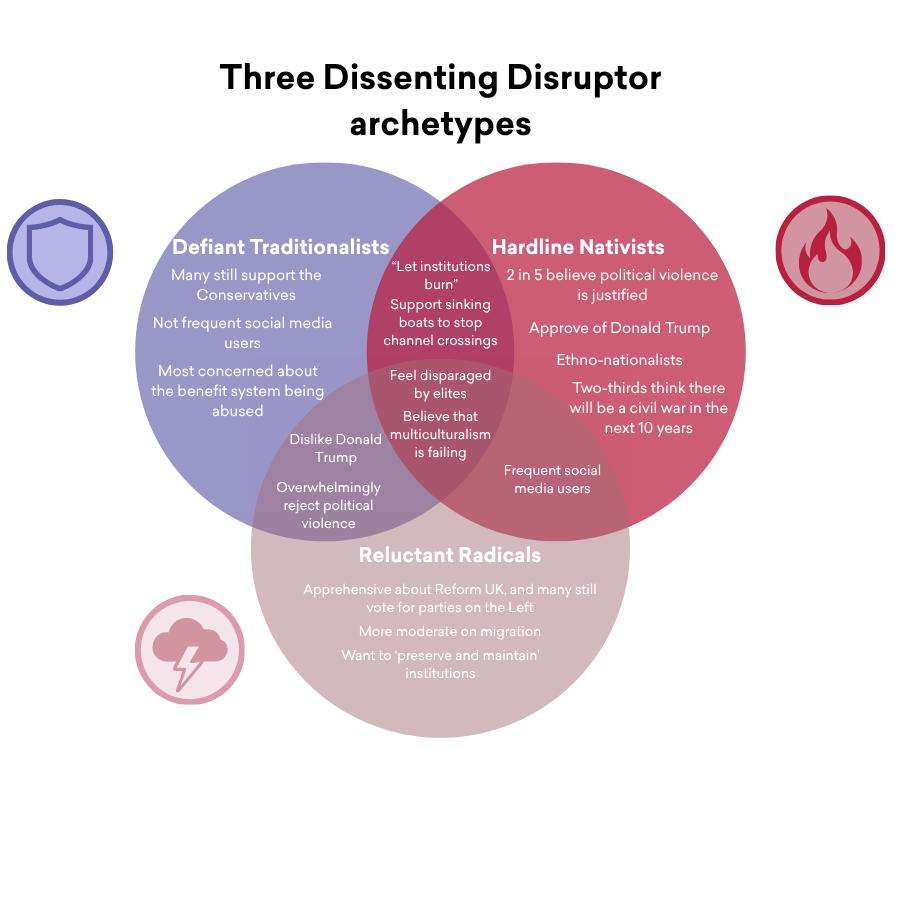
There are variations among Dissenting Disruptors, both in terms of what they believe and how strongly they hold their beliefs. In particular, there are three broad archetypes:
- Reluctant Radicals: disillusioned and anti-system, frustrated with the status quo, but uneasy about the most radical solutions. Roughly five per cent of Britons are Reluctant Radicals.
- Defiant Traditionalists: culturally conservative and anti-elite but seeking to restore traditional norms and order rather than overturn the system entirely. Roughly eight per cent of Britons are Defiant Traditionalists.
- Hardline Nativists: the most radical and absolutist, deeply distrustful of institutions and often willing to back extreme, anti-democratic measures to fundamentally reshape the country. Many hold actively racist views. Roughly six per cent of Britons are Hardline Nativists.
These archetypes bring nuance to a group that, as a fifth of the UK’s population, is a significant part of Britain. They also provide an analytical framework for understanding the divergence and convergence of beliefs both among Dissenting Disruptors themselves and the wider British public.
Many priorities and concerns of Dissenting Disruptors are widely-felt across the public. These concerns – including about illegal migration – should not be dismissed as beyond the mainstream or beyond the pale.
However, Dissenting Disruptors are more out-of-step with the median of the public when it comes to attitudes toward minority groups in Britain, and particularly in their views on Islam. Some hold openly racist views. Distinguishing clearly between these beliefs shows which are fringe (and indeed not even shared among many populist right Britons themselves) when it comes to ethnic minorities, political violence and gender equality in Britain today.