
What would Britain look like with proportional representation?

Our new modelling for the Guardian uses our MRP to project what British politics would look like with different voting systems.

First-Past-the-Post (FPTP), the system we use to vote in general elections, is meant to have a major selling point: clear majorities and stable governments. Yet our latest MRP suggests that an election held tomorrow would result in a hung parliament, with Reform UK 30 seats short of a majority. And with a former advocate of proportional representation in Downing Street, the debate around our voting system has opened up again.

Our new modelling for the Guardian uses our MRP to project what British politics would look like with different voting systems. 

To model these different voting systems, we put a set of questions to voters alongside our usual voting-intention question, asking how they would vote under each hypothetical system. What we cannot predict is how parties would campaign, or which parties might fragment, merge or emerge under a more proportional system.

The current FPTP system would give Reform 46 per cent of the seats off just 28 per cent of the vote, in touching distance of a sizeable coalition if the Conservatives lent their support. The proportional systems would not give Reform such a boost: regional party list is estimated to give them 28% of seats off 28% of the vote; AMS would give them 33% of the seats off 28% of the vote; and STV would give them 27% of the seats off 26% of the vote.
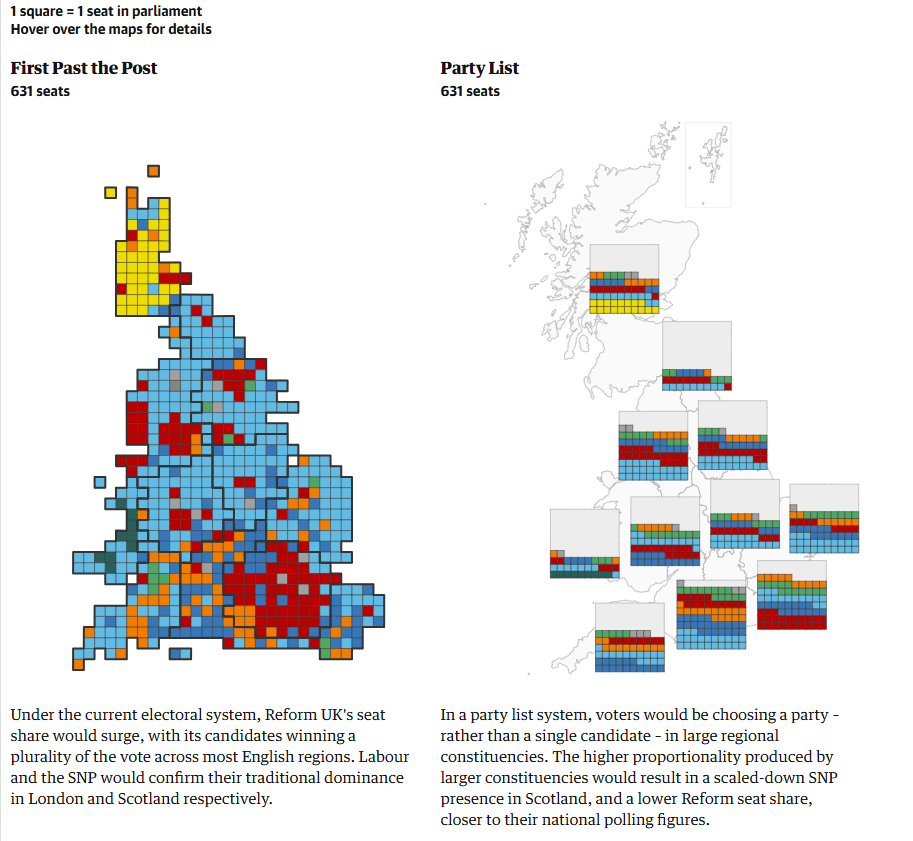
Under each of these systems, either a progressive coalition of parties – consisting of a combination of Labour, the Lib Dems, the Greens, the SNP or Plaid Cymru – or a Reform-Conservative coalition would be the only paths to forming a government.

In a purely proportional list system, tactical considerations should largely disappear: there is no need to back the candidate seen to be ‘winning here’. Without the advantage of being the largest party, Reform UK would lose almost 40 per cent of their seats. Without the advantages of a concentrated vote, the Scottish National Party would lose more than half of theirs, while the Greens – currently punished by a wide geographic distribution – would see their number of seats increase by 770 per cent.

What’s really striking about the results is that the two traditional parties’ fortunes only slightly change – showing that they are no longer the main beneficiaries of First Past the Post. 

Read the excellent Guardian piece below:

Subscribe to
our newsletter

Get the latest polling data, insights, and analysis delivered to your inbox.

We’ll never share your details. By signing up you agree to receive communications from More in Common. Read our Privacy Policy.