Hypothesis 1: Polling error was to do with our voting intention adjustment methodology
Throughout the course of the election campaign this year, much of the discussion about polling methodology focused on adjustments that pollsters were making to transform their ‘raw’ data (that is, direct answers to the question of how people say they will vote) into their final headline snapshots for how the country would vote at that point in time. In particular, many pollsters make adjustments to account for turnout (as more people say they will vote in polls than actually vote) and undecided voters.
There has always been variation in how pollsters make these adjustments, but at this election, some pollsters made more adjustments to their raw voting intention figures than in previous election cycles, and the variation between pollsters’ methodologies was much larger than it ever has been. For many pollsters, this experimentation paid off – JL Partners and YouGov both tried innovative methods this election and performed among the most accurate in the industry. The need for experimentation was mostly due to one specific issue: heading into the 2024 General Election, undecided voters were not representative of voters in general – they were much more likely to have voted Conservative in 2019. So simply discarding undecided voters and reallocating them potentially risked missing part of the picture.
To overcome this, we asked undecided respondents a ‘squeeze’ question – who they would vote for if forced to choose. And because many people still don’t make up their mind even when prompted in this way, we used a statistical model to estimate who the remaining voters were most likely to vote for based on how they compare to similar voters.
All this amounts to a fair amount of adjustment occurring between our raw data and our headline results – so it is reasonable to assume that a flawed assumption in these adjustments could be driving the error in our final result.
In practice, however, our voting intention adjustments had limited impact on our final results, and where our adjustments did make a difference, they tended to bring the polling closer to the real results:
Between our unadjusted weighted data and our headline figures, the Conservative vote share changed by 2.7 points, the Green Party by 1.6, and all other parties changed by less. So the adjustments did have the desired effects of removing unlikely votes (who are more Labour leaning) and exposing undecided Conservative voters. This resulted in our Labour vote share being around 1 point closer to the final result, and our Conservative vote share being almost three points closer than it otherwise would have been.
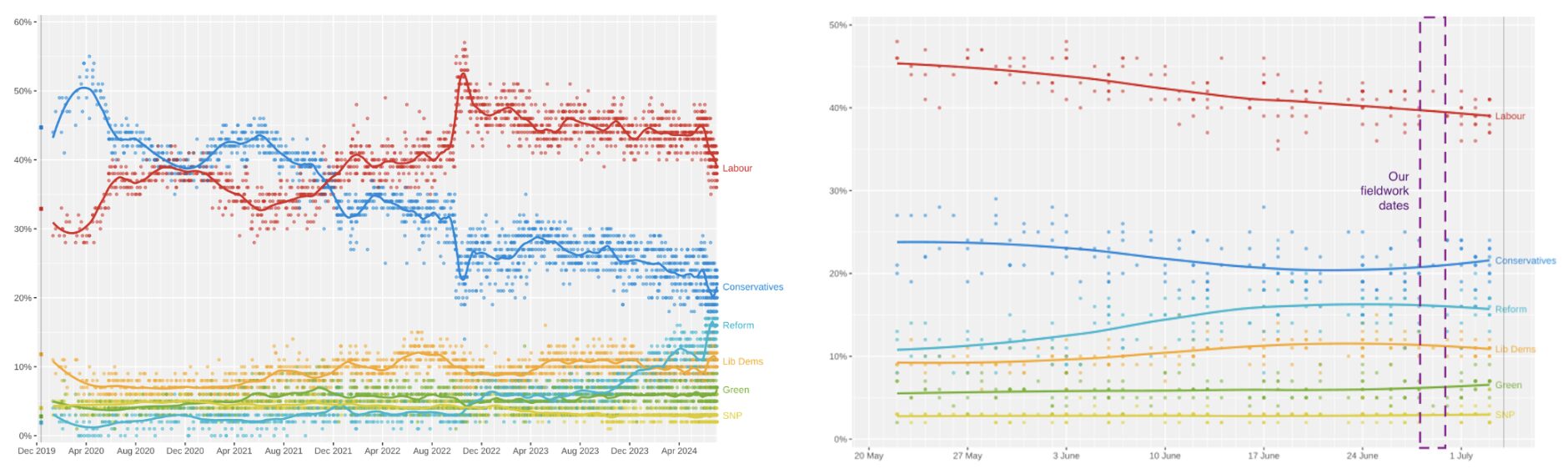
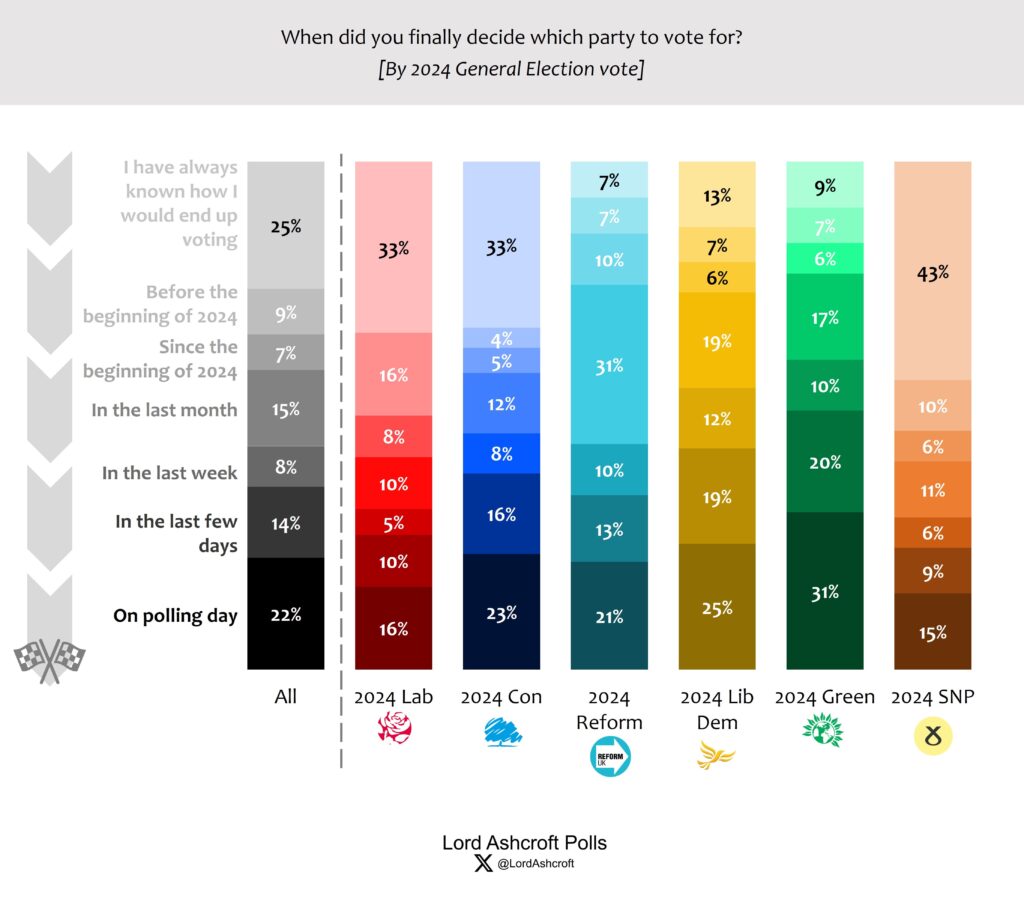
At the same time, our adjustments became less influential on final voting intention numbers towards the end of the election campaign than they did at the start. In many ways this is to be expected – reallocating undecided voters has less impact closer to an election when more people make up their minds (indeed the gap between ‘nowcasting’ and ‘forecasting’ pollsters did close as the election campaign went on, particularly with the Labour vote). It therefore seems likely that our adjustments helped bring our final poll closer to the final result and were not a major (or even a minor) cause of polling error for the major parties.
Our turnout model takes into account voters’ age because we know that younger people are less likely to vote. But in this election we underestimated the Green Party’s performance in part because many young Green voters were modelled as unlikely to vote, in line with previous elections. When the post-election British Election Study dataset is released, it is possible that we discover our turnout modelling was too restrictive on young people this election, and we will adjust it accordingly.
Of course, it is possible to argue that our adjustments were flawed because they did not do enough to bring our raw data closer to the final result. We have explored many approaches to modelling turnout and undecided voters, but on the raw data we collected no combination of adjustments is more effective. We’re also publishing our microdata from our final poll to support others investigating the same, and once we are able to draw final conclusions from the BES post-election survey we will update our methodology accordingly .
The verdict: Our adjustments generally helped expose undecided Conservative voters and quash those who said they would vote Labour but were unlikely to vote, bringing both vote shares in the poll closer to the final result. But by the time of our final voting intention poll, our adjustments had a more limited impact on the overall result, as fewer people were still undecided about who they would vote for. As such, it seems unlikely that our adjustments would be a major cause of polling error.



.svg)