Is Labour safe anywhere?
Labour is projected to fall to just 101 seats, a loss of 310 MPs from their July 2024 landslide.
The party would be reduced to a rump of urban strongholds: London boroughs, university cities such as Cambridge, Oxford East and Sheffield Hallam, parts of Merseyside and a scattering of metropolitan centres.
Labour strongholds under siege:
- A month out from the Senedd Election, Labour loses the Welsh valleys, including seats that have voted Labour for over a century. In these seats, Labour defections to Plaid Cymru allow Reform to take control of South Wales.
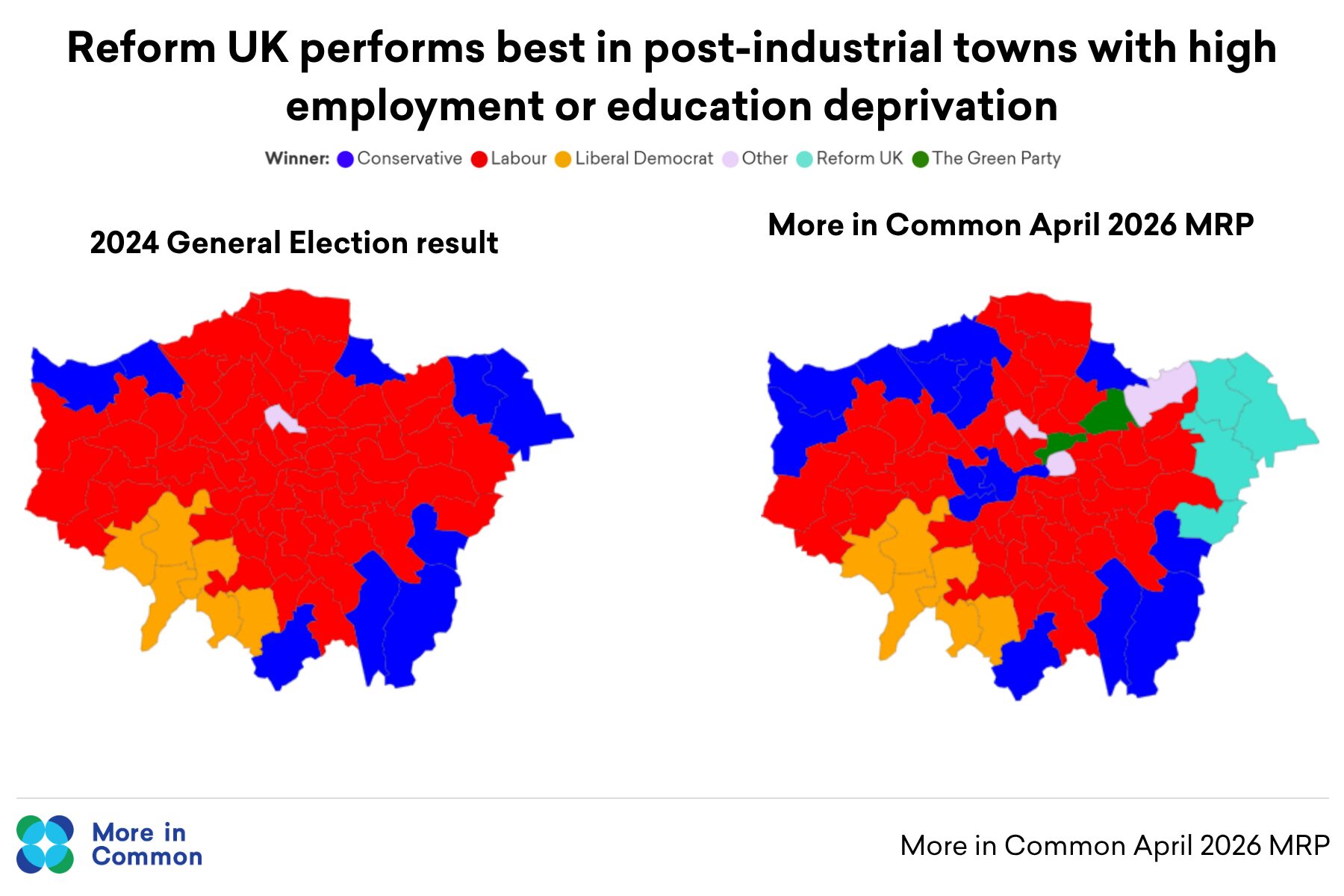
- Labour under siege in London: In London, Labour could keep just 46 of London’s 75 seats (a decrease of 13 since 2024), losing ground to the Greens, Liberal Democrats, Conservatives, Independents and even Reform UK.
However, this result is slightly more positive for Labour than More in Common’s January MRP, which saw Labour projected to lose an additional 17 seats
The Green rise
The Greens are projected to quadruple their parliamentary presence from 5 to 22 seats – a significant breakthrough into Westminster politics
- Gains come from Labour defections in progressive cities including Bristol, Manchester, Sheffield and parts of London, while retaining existing strongholds in rural constituencies Waveney Valley and North Herefordshire.
- Greens have room to grow further: the Green Party vote remains inefficient, with 12% per cent of the national vote translating to just 22 seats – but coming second in 38 seats represents potential for gains to grow.
Greens in second place to Labour in 26 London seats – and 10 of these are marginal races (won by Labour with a margin of less than 5 per cent).
Liberal Democrats remain stable
The Liberal Democrats are projected to win 62 seats, down 10 from their 2024 result but broadly defending their gains.
The Liberal Democrat vote is distributed efficiently in their target seats, and they remain the strongest challenger to the Conservatives across much of southern England and the South West.
London divided
Labour holds London – but is under siege from left, right and centre.
In this projection, Labour would lose 13 seats. leaving them with just 46 of London’s 75 seats.
The Greens come second in 26 London seats – more than any other party. In Walthamstow, Lewisham North, and Hackney North and Stoke Newington, the gap between Labour and the Greens is under two percentage points. The Greens win outright in Hackney South and Shoreditch, and Leyton and Wanstead.
Outer London may also be carved up by Conservatives and Liberal Democrats: The Conservatives gain 7 seats from Labour while holding their existing 7 outer London seats. The Liberal Democrats hold all 6 of their south-west London seats.
Reform breaks into outer east London: Dagenham and Rainham, Hornchurch and Upminster, Romford and Bexleyheath and Crayford all fall to Reform
Three seats fall to independents: Islington North, Ilford North and Bethnal Green and Stepney all go to independent candidates
FAQs and Methodology
Sample size: 15,482
Fieldwork dates: 1st – 30th March 2026
What is an MRP?
‘Multilevel Regression with Post-stratification’ (MRP) uses data from a voting intention poll to model how people will vote based on their demographics, voting behaviour and information about their constituency. These results are then applied to the demographic and electoral makeup of each constituency to make a constituency-level estimate. The model is ‘multilevel’ because it uses both individual and constituency-level data.
How is this different from your normal voting intention poll?
The voting intention regularly published by More in Common is a national estimate based on a representative sample of at least 2,000 people. It indicates roughly how many people in Great Britain intend to vote for one party or another. This is simple to calculate and allows us to track changes through time.
But if you want to estimate a national seat count, this isn’t as useful. No political party performs equally well in every seat, because their supporters are not evenly spread across the country. For example, a 70-year-old man who didn’t go to university and lives in a small village has a higher likelihood of voting Conservative than a 25-year-old woman renting a flat in a major city.
The benefit of MRP is the ability to use information about the different people who live in every constituency across the country to estimate how many people will vote for each party.
How does the model account for those who don’t know how they will vote?
When we ask people their voting intention, some people say they don’t know. We push them to say who they would vote for if they were forced to choose, and we use this response as their expected vote. Some people, when asked to imagine that they were forced to choose, still don’t know who they would vote for. Using our MRP model, we’re able to make a better guess at how these “double don’t knows” might end up voting. When training the model to predict people’s voting intention based on their demographics, voting behaviour and information about their constituency, we excluded the responses of people who didn’t know who they would vote for (after the squeeze) from the training data. When we apply the model to all the voters in the constituency, it effectively means we estimate the votes of people who don’t know, according to how people like them (in terms of demographics and past voting behaviour) but who do know, intend to vote. So if someone lives in a rural area, is over 75 and voted Conservative in 2024, the model uses the fact that most over 75s in rural areas who voted Conservative in 2024 and do know who they’ll vote for say they will vote Conservative, to guess that if they do vote it will likely be for the Conservatives.
Is this a snapshot or a projection?
With three and a half years before the next General Election must be called this model is unlikely to represent anything close to the ultimate result and should not be seen as a projection of the election.
As well as not knowing what might happen between now and 2029, we also don’t know which parties will stand in different seats, what tactical voting might look like exactly and who will ultimately turn out to vote. What’s more, the degree of electoral fragmentation makes individual seat dynamics even more difficult to project than previously.
Instead this model provides a baseline for how the electorate has fragmented since the last General Election and what the implications of that might be for the make up of a future Parliament. We will continue to update it throughout the next Parliament and introduce new data as it becomes available.
Why does the model show X party winning in Y constituency?
MRP models are a good way to estimate how the parties might perform across different constituencies based on their demographic makeup. However, they don’t account for local factors that impact a small number of constituencies, such as a popular incumbent, well known or controversial council policy. These factors make it difficult to predict exact vote shares even in the best of times, but even more so when three parties are polling at over 20%, making three-way races more common. Therefore it would be a mistake to draw too much from the estimated vote share in an individual constituency.