More in Common has partnered with the AKO Storytelling Institute at the University of the Arts London to research and tackle misinformation in more novel and engaging ways. While this report focuses on those who are most vulnerable to misinformation, its findings speak to a wider context in which the population at large is increasingly likely to encounter and engage with misinformation in the years ahead.
The research uses videogames as a vehicle for exploring inoculation theory, the latest method developed by psychologists to make populations more resilient to misinformation. Because misinformation is a growing problem across Britain and the wider world, this project is grounded in the belief that finding innovative and engaging ways to help people build resilience is central to combating it.
Drawing on two commissioned videogames, a poll of 2,000 Britons and a series of focus groups, the research has approached the issue collaboratively, combining the expertise of psychologists, games developers and public opinion researchers with the perspectives of artists and, ultimately, the players themselves.
Why does gaming matter to misinformation?
Trust in Britain is at a low point: almost two fifths of Brits (39 per cent) say that they no longer trust the BBC. These low levels of trust drive chronic problems in society, from political polarisation and waning faith in democracy to the growing sense that society really is divided into us versus them.
People who game more frequently are also more likely to believe in conspiracies. Nearly two thirds (64 per cent) of those who game most days believe that secret groups control major global events, compared with less than half of those who never game. This matters because young men aged 18 to 24, who sit at the epicentre of the conversation about political disenfranchisement in the UK, are the most likely group to game.
The research project’s focus groups reinforced the point: many of those who report low trust in traditional and established media nevertheless play and enjoy videogames regularly. That combination makes videogames an ideal way to reach people who are increasingly detached from mainstream media.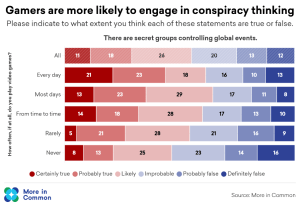
“I quickly went off it [politics] when I saw how corrupt it was and how little, it’s sad, but how little influence that you had… So now I try and stay away from it, if I’m honest. I don’t watch the news or anything like that because it’s just so depressing and I don’t believe half of the stuff in the mainstream media. So I now look to alternative sources.” – Luke, gamer, 28.
What’s the problem?
Everyone is susceptible to misinformation, and most mainstream media literacy training is struggling to achieve cut-through fast enough to keep pace with the problem’s rapid growth over the past few years. More in Common research shows that videogames are played across all segments of the public, including the most politically disengaged and disenfranchised. Over half of UK adults play video games at least occasionally, and 30 per cent play for four hours or more each week.
Paradoxically, the most digitally native group is also the most likely to overestimate its ability to spot misinformation: those who game daily are four times as likely as those who never game to be very confident in their ability to identify it. Yet those who are most vulnerable to misinformation are among the least likely to say they want to play a game that teaches media literacy, with only one in five daily gamers saying they would be really interested in a game about identifying misinformation.
Video games therefore offer an opportunity to reach a vast range of people, including those who are most vulnerable to misinformation and least trusting of mainstream media, and to introduce them to the principles of inoculation.
The project
The research project began with preliminary focus groups, speaking to people who are disenfranchised with mainstream politics and media but who still play videogames, and asking them why, how and when they played, and what they enjoyed most.
“You see how rich it is… you see the time and the effort… the heart that has been put into these games… it gets you involved, it takes you off… even when you’re not playing the game, you are thinking about the game… If you’re thinking about the game after you’ve played it, you’ve clearly experienced a great story” – Jack, 24
These insights were shared with a group of professional game developers and academics specialising in countering misinformation, convened by the AKO Storytelling Institute. Together they developed mechanisms that combine the latest methods for countering misinformation with genuinely enjoyable, playable game mechanics, such as unreliable narrators, uneven social dynamics and the scope for multiple perspectives within a single game. These mechanisms draw specifically on inoculation theory in order to better equip the public to distinguish between fact and fiction. Inoculation works by going upstream of disinformation, introducing the ideas that knowledge is precarious, that we are all socially biased, and that we are often open to emotional manipulation.
Informed by More in Common’s insights, the AKO Storytelling Institute commissioned two prototype videogames built around these anti-misinformation mechanics: Bezerkerz and Solomon’s Secret. Both were tested with participants who hold low levels of trust in mainstream media, with some success, although a number of participants felt betrayed once they realised they had been playing games that tackled misinformation without their knowledge.
The project also identified existing games that contribute to this ecosystem. Among Us, for example, uses social bias and influence to show how groups shape one another’s thinking in the face of suspicion, while Papers, Please foregrounds the way players judge sources through their own internal biases, challenging them to weigh the information and trustworthiness of competing sources as they work in border security.
Key findings
A clear tension runs through the project: many players value videogaming precisely because it is a space free of political ideology. Most treat games as an alternative to the moral, political and gritty reality they live in, and they want them to stay that way. There is therefore a balance to be struck between games that lean too heavily on a “learning outcome” and those that prioritise playability. Overemphasising either tends to come at the expense of the other, but the two need not be mutually exclusive.
Collaboration is essential to bring the lessons, needs and desires of players together with the knowledge of game designers and psychological experts. Understanding the audience is equally central to any media literacy intervention: if the target audience does not feel that the medium speaks to them, any downstream change becomes highly unlikely. Independent games developers have been at the forefront of developing ethical games, and they should be empowered to drive change and share knowledge.
Inoculation and psychological resilience can offer longer-term, passive protection against dis- and misinformation, in contrast to traditional “debunking” methods. For this to work, the relevant mechanics should be integrated directly into gameplay rather than made the subject of the game itself. Doing so broadens a game’s appeal and avoids alienating the already disengaged, who tend to be most wary of overly didactic media.
Where do we go from here?
This research has sparked interest across both the misinformation sector and the games industry in how the two might come together to tackle one of the defining challenges of the coming decades. There is now clear evidence that inoculation can be an effective route to building long-lasting resilience to misinformation among a wide audience, including many people who are unwilling to engage with traditional media literacy training. Videogames offer a way to connect both with the disconnected in society and with the many people who simply play and enjoy games along the way.