Key findings:
- Labour leads with the highest vote share in 21 of 32 boroughs, but loses ground on all sides – the Greens are the second-placed party in half of all Labour-held boroughs, and Labour are estimated to fail to top 40 per cent anywhere in the capital.
- The model estimates the Greens will get the highest vote share for the first time ever in a London borough – leading in Hackney by 3 points – and within two points of Labour in three more (Islington, Lambeth, Lewisham).
- Reform UK breaks through in the East, estimated to take the most votes in Havering and making Bexley a very close fight with the Conservatives.
- The Conservatives are reduced to leading in just five outer London strongholds
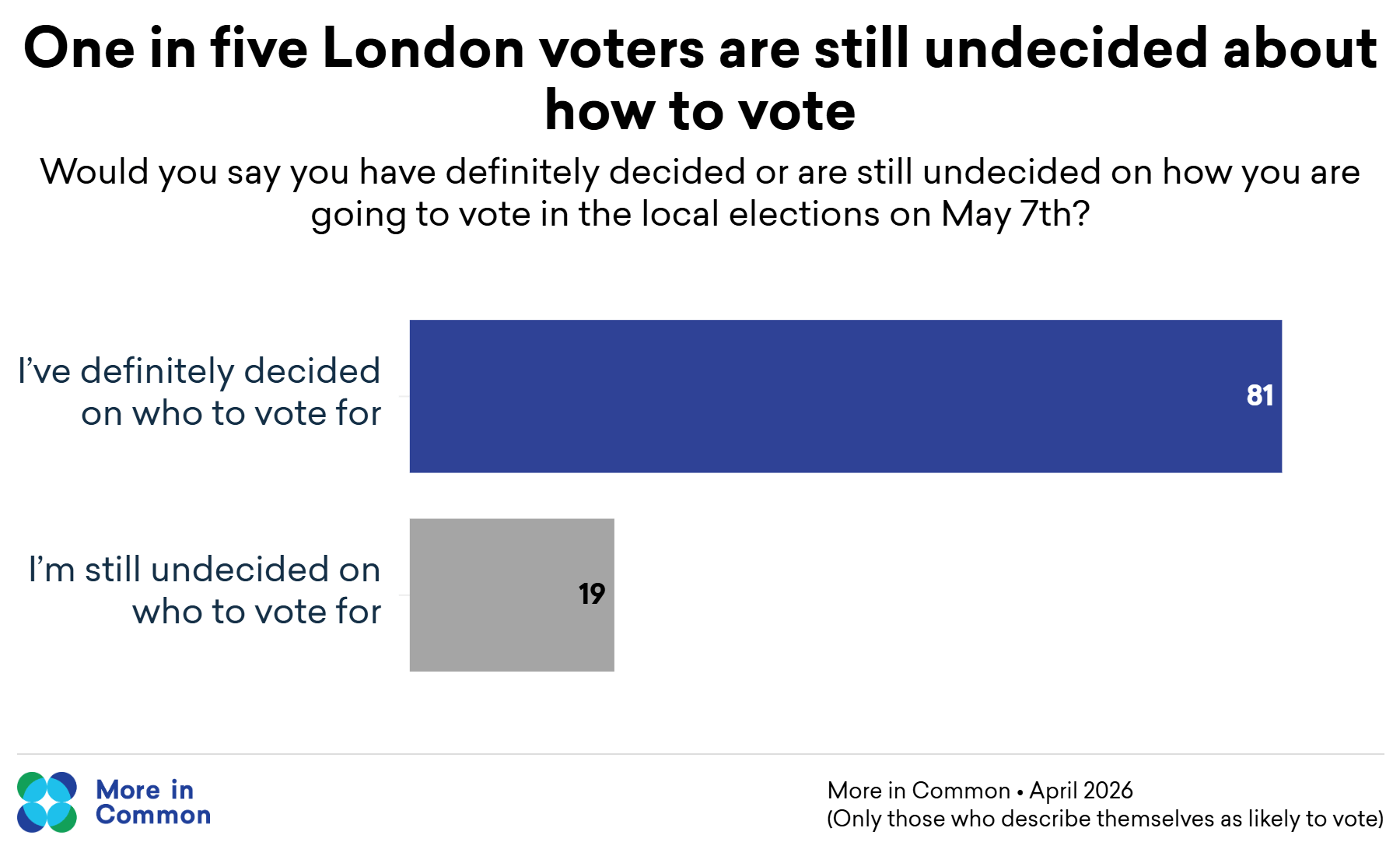
- With a fifth of London voters still undecided (19 per cent), and several councils on a knife edge, much is still to play for.
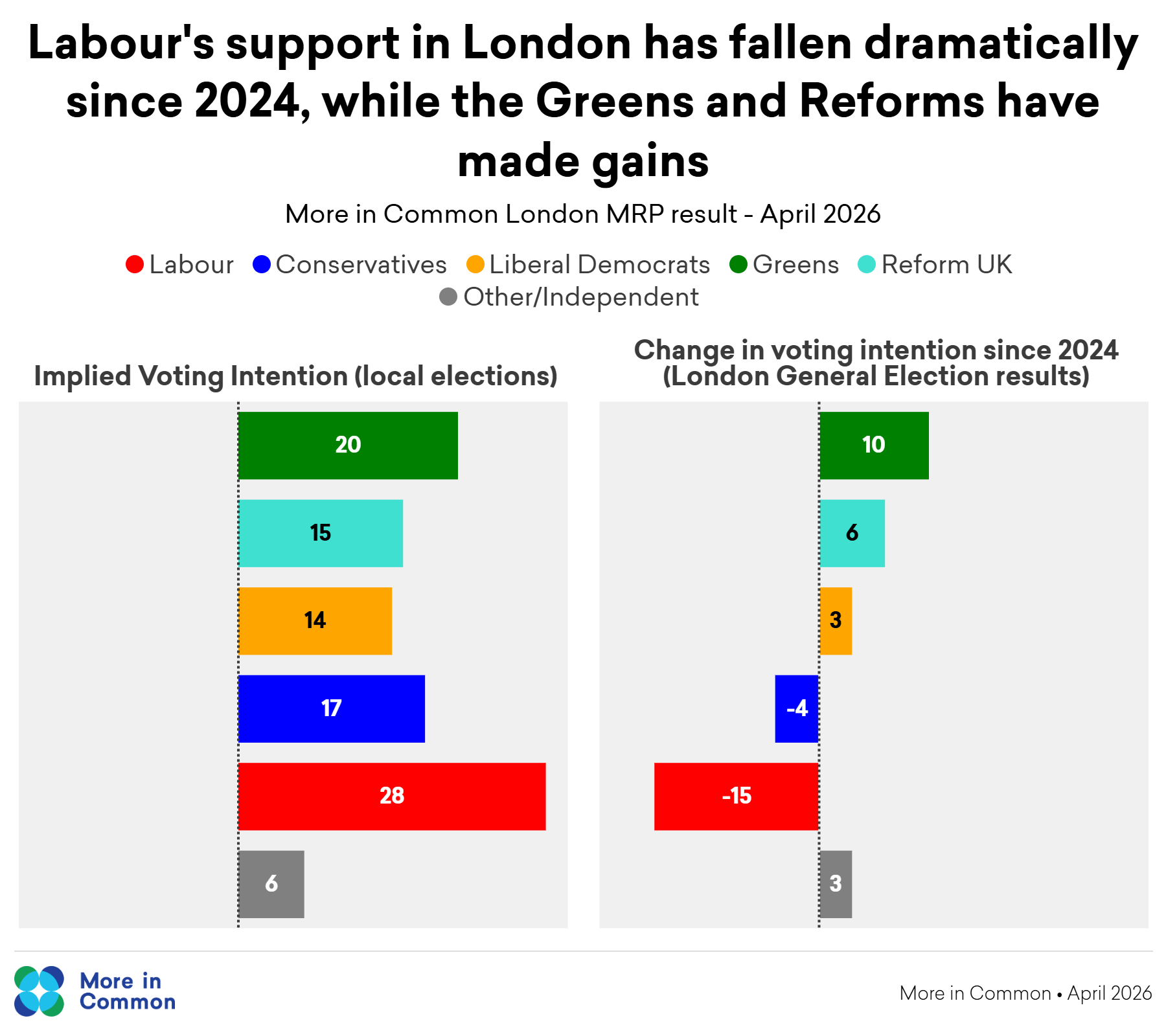
| Councils Leading on Vote Share | Implied Voting intention | Change in vote share since 2024 General Election | |
| Labour | 21 | 28 | -15 |
| Conservatives | 5 | 17 | -4 |
| Liberal Democrats | 3 | 14 | +3 |
| Greens | 1 | 20 | +10 |
| Reform UK | 1 | 15 | +6 |
| Independents & Others | 1 | 6 | +3 |
Insurgent parties breaking through in London
More in Common’s London MRP suggests the political map of London is likely to be upended as the electoral fragmentation which has dominated much of the rest of the UK hits the capital. Labour’s vote share has fallen 15 points in London since the 2024 General Election, the Conservatives are down four points, and the combined vote of the two traditional parties has fallen by 19 points.
That ground has been seized almost entirely by insurgent parties: The Green Party’s support has increased by 10 points since 2024, while Reform UK are up 6 points.
Councils that Labour previously dominated such as Hackney, Lewisham, Newham, Islington and Lambeth are now a two-way fight between Labour and the Greens. Meanwhile the Conservatives may struggle to regain traditional strongholds such as Westminster and Wandsworth and face an assault from Reform in Havering, Bexley and Bromley.
The Liberal Democrats are the only traditional party that look set to avoid the assault on the traditional mainstream, holding comfortable leads in their south-west strongholds and challenging Labour in Merton.
Labour stays on top in the capital, but is besieged on all fronts.
More in Common’s first MRP for London suggests that Labour will top the poll in London, leading in 21 of 32 boroughs. But on a significantly reduced vote share with previously loyal Labour voters fragmenting in multiple directions, but particularly to the Greens.
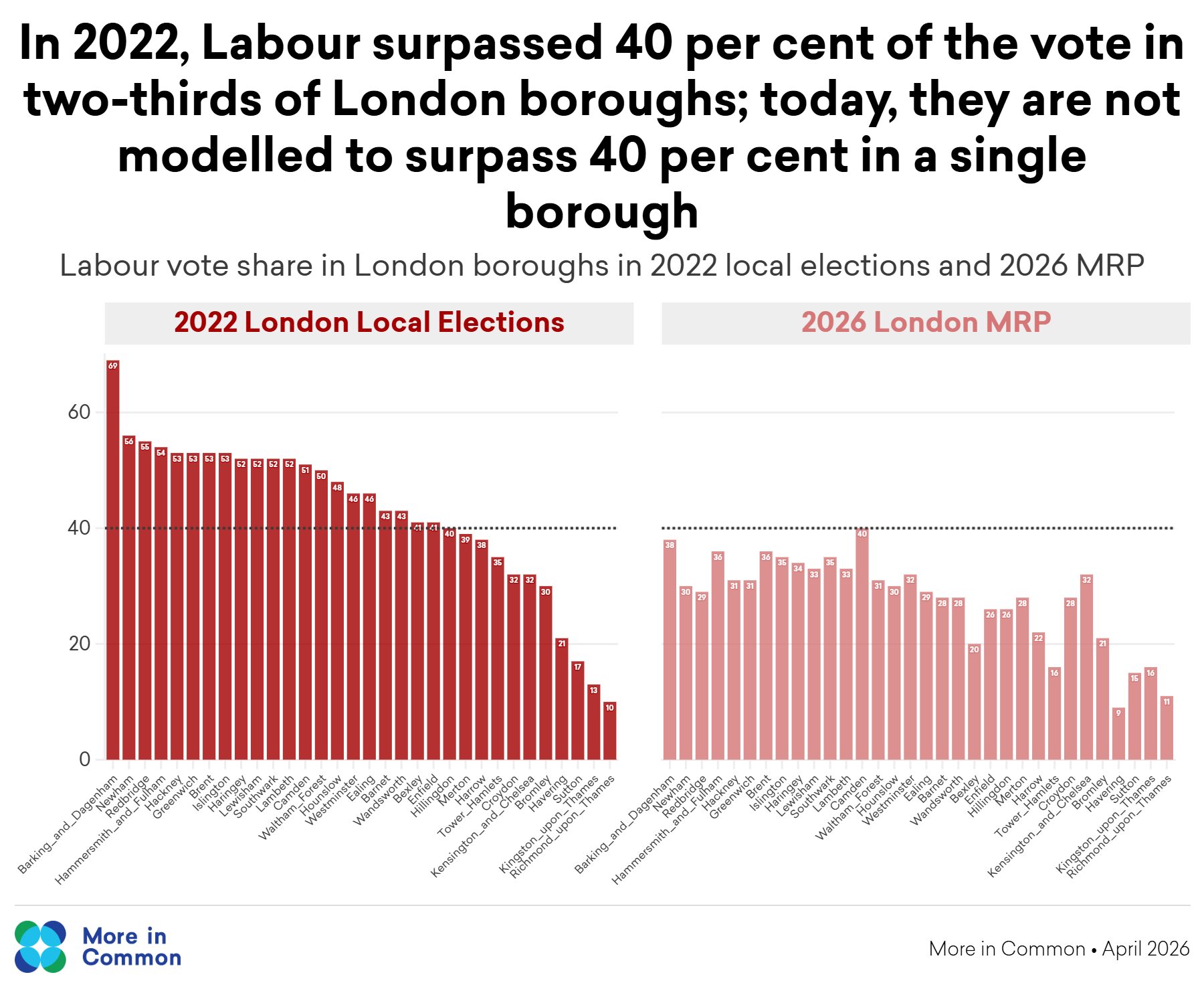
- Labour does not break 40 per cent in a single borough according to the model estimates. Its strongest performance is in Camden (39.8 per cent), followed by Hammersmith and Fulham (36.6 per cent) and Brent (36.5 per cent). For reference, in 2022 Labour won more than 40 per cent of the vote in two-thirds of all London boroughs (21 councils of 32).
- The Greens are the second-placed party in 16 of Labour’s 21 boroughs – meaning the main threat to Labour in the capital now comes from its left, not its right.
- The squeeze is most dramatic in inner London: The Greens are estimated to lead the vote in Hackney and in Islington, Lambeth and Lewisham, Labour leads the Greens by less than two points, an effective coin toss, in Enfield – and Newham by less than five.
Greens top the poll in their first ever London borough
The Greens are projected to top the poll in Hackney, edging Labour by 3 points (34 per cent to 31 per cent).
They are estimated to come second to Labour in 16 boroughs, and fall within 5 points of Labour in five of them – putting almost a third of the capital within the Green reach.
Their strongest performances are concentrated in inner-east and inner-south London – Hackney (34.1 per cent), Islington (34.3 per cent), Lewisham (32.2 per cent), Lambeth (31.8 per cent), Haringey (27.5 per cent), Southwark (25.0 per cent) and Newham (25.1 per cent).
The Greens increase their vote share in every borough. Their biggest relative gains, however, do not come in inner-east and inner-south London but in West London: Westminster (20 point gain), and Hammersmith and Fulham (18 point gain).
Reform breaks through in the outer East
Reform UK is on track to make gains across outer London.
Reform is projected to lead the vote in Havering on 32.8 per cent, with the closest challenger more than 9 points behind.
In Bexley, Reform is neck-and-neck with the Conservatives (30.4 per cent to 30.7 per cent), making it the tightest of the races More in Common is estimating
Reform perform strongly in Barking and Dagenham (24.3 per cent) – where Labour won every single seat in 2022 – and in Bromley (21.3 per cent).
Reform’s London-wide vote share is estimated to be 14.5 per, just 3 points behind the Conservatives in what has traditionally been their weakest part of the country.
Reform also overperforms in outer north and north-west London. Hillingdon is close to a three way tie between Labour, Reform and the Conservatives. In Harrow (19.2 per cent), Barnet (17.5 per cent) and Enfield (18.4) Reform also come third but with notable vote shares above their London average.
The Conservatives reduced to a handful of outer London strongholds
The Conservatives still lead in five boroughs – Bexley, Bromley, Harrow, Hillingdon, and Kensington and Chelsea – but are pushed into third place on average vote share, behind Labour and the Greens, and just ahead of Reform by just 2 points.
Their strongest showing is in Kensington and Chelsea on 34.9 per cent.
Two of their five seats are knife-edge marginals: Bexley (0.3 points over Reform) and Hillingdon (0.4 points over Labour).
In every outer eastern borough they hold, the Conservatives are now outpolled or matched by Reform.
The Conservatives do not look set to offset their bad night elsewhere in the country by regaining traditional strongholds such as Wandsworth and Westminster – they trail Labour by 7 points in Wandsworth and 11 in Westminster.
Liberal Democrats consolidate the south-west
The Liberal Democrats lead in three south-west London boroughs in commanding positions:
Richmond upon Thames (41.9 per cent, a 23-point lead over the Greens), Kingston upon Thames (33.1 per cent) and Sutton (31.4 per cent).
This makes the south-west the only part of London where the Lib Dems are the dominant force. In another south-west borough, Merton, the Lib Dems could well challenge Labour’s for control as Labour’s vote share falls by 11 points.
Councils across London too close to call
A high degree of marginality means control of several councils is impossible to call, with small swings potentially shifting multiple wards.
Nine boroughs sit within touching distance of a change in first place. The tightest contests are in outer London, where Conservative–Reform races in Bexley and a three-way Conservative–Labour–Reform fight in Hillingdon are effectively level-pegging, and where Reform’s lead over local independents in Havering is narrow. Inner London adds a further cluster of Labour–Green contests: Islington, Lambeth and Lewisham are within a point of each other on our central estimates, with Enfield not far behind.
Luke Tryl, UK Director at More in Common, said:
“The 2026 elections are set to show that the capital is not immune to the electoral fragmentation that has upended politics across the country.
Former Labour strongholds look set to see major Green gains with the potential the party controls or emerges as the largest party in a whole swathe of inner London.
While the Greens advance in Labour’s heartlands, Reform looks set to do the same in outer-London boroughs such as Bexley that were previously safe for the Conservatives.
Add in gains from Independents and it could well be that the electoral map of London we see on May 8th looks totally unrecognisable to what we have become used to.”