• Insight
  • 4 May 2026

Party

Seats

Implied vote share

Vote share changes since 2021 regional list vote

Seat changes on last MRP

Plaid Cymru

34

30%

+9

+4

Reform UK

34

27%

+26

+6

Labour

14

16%

-20

-10

Conservatives

9

12%

-13

+2

Greens

5

9%

+5

+1

Liberal Democrats

0

4%

-

-3

Wales heads for a hung Senedd with no clear path to government

More in Common's latest MRP for the 2026 Senedd Election projects a dead heat: Plaid Cymru and Reform UK tied on 34 seats each, with neither party close to the 49 needed for a majority. It is unclear who would form the next Government.

Meanwhile the model suggests Labour could fall into third place with just 14 seats. In an echo of the Caerphilly by-election it seems that as the election approaches Labour’s voter share is being squeezed, particularly by Plaid, with progressives rallying behind ap Iorwerth’s Party as the best vehicle to stop Reform.

The Conservatives would end up with 9 seats (their position stabilising since early April), and the Green Party would end up with 5 - their first ever seats in the Senedd.

Since More in Common’s last MRP model in early April, Plaid have moved into a lead over Reform UK in vote share, but are now tied in terms of seats, with the “6th seat” and handfuls of votes likely to prove pivotal. 

Previously a coalition between Plaid Cymru and Labour would have given them a comfortable majority (54 seats) but the collapse of Labour means even a Plaid–Labour coalition could be one short of a majority (48 seats).

This means that they would either have to govern as a minority, or enter into a three party coalition with the Green Party.

Plaid leader Rhun ap Iorwerth has previously said he would prefer to lead a minority government, but on these numbers Reform UK could reasonably make a similar claim, especially if bolstered by the Conservatives.

Plaid Cymru tops the vote share

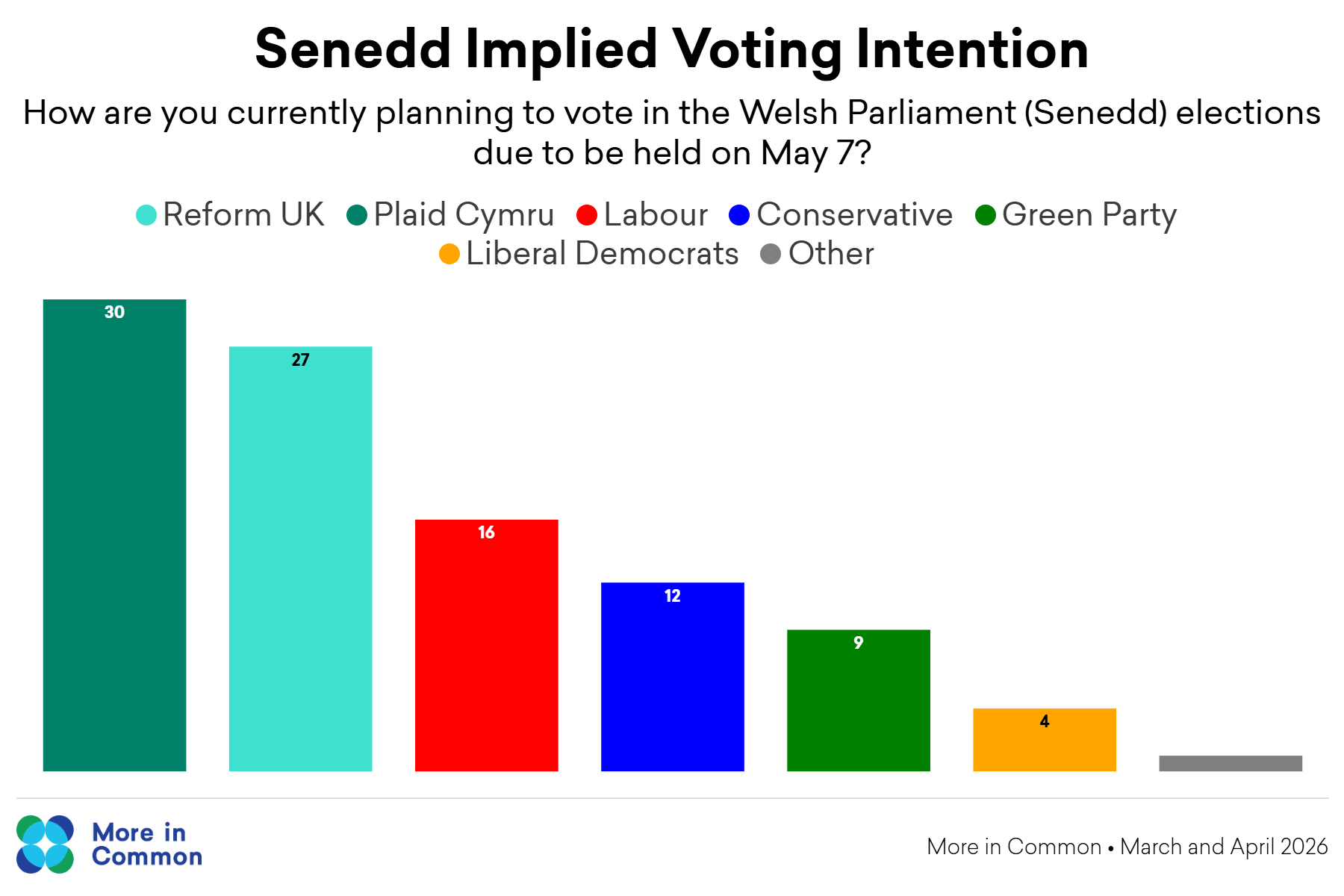
Plaid Cymru leads on the headline vote share, on 30 per cent of the vote, while Reform trail closely behind on 27 per cent. 

Plaid's support is strongest in North and West Wales. They command sizeable leads of between 11 and 30 percentage points in Bangor Conwy Môn (47 per cent), Ceredigion Penfro (43 per cent), Gwynedd Maldwyn (41 per cent), and Sir Gaerfyrddin (40 per cent).

Plaid is also making gains in urban areas, leading in both Cardiff seats - Caerdydd Penarth (28 per cent) and Caerdydd Ffynnon Taf (26 per cent).

27 April SENEDD IMPLIED VI@2X

Reform set to share top spot in the Senedd

Reform UK is on track for an extraordinary breakthrough, having barely contested the 2021 Senedd Election to potentially level-pegging with Plaid on 34 seats. 

While still far from the 49 seats needed to form a majority government, Reform UK would find themselves in a reasonable position in the Senedd; if they decided to form a pact with the Conservatives, they would have 43 seats - just 6 short of a majority.

Reform is estimated to top the poll in 9 out of 16 constituencies, more than any other party. Their strongest performances are in the Valleys and Newport: 37 per cent in Casnewydd Islwyn, 36 per cent in Afan Ogwr Rhondda, 35 per cent in Blaenau Gwent Caerffili Rhymni, and 32 per cent in Pontypridd Cynon Merthyr.

Labour facing historic collapse in Wales

After leading the Welsh Government for nearly three decades, Labour is set for its worst Welsh result in a century, pushed into third place and losing every single constituency. The result would certainly deliver the first non-Labour First Minister since devolution.

Labour leads in none of the 16 constituencies, and does not top 21 per cent of the vote in a single one. Its strongest performance is 21 per cent in Caerdydd Penarth, where it still finishes second behind Plaid.

Labour is being squeezed simultaneously from the right by Reform UK and from the left by Plaid Cymru and the Greens.

The party is set to lose its historic Welsh Valley strongholds. In Afan Ogwr Rhondda, Blaenau Gwent Caerffili :Rhymni, and Pontypridd Cynon Merthyr, Reform leads Labour by between 16 and 19 points.

Eluned Morgan could to fail to win a seat: in her new constituency of Ceredigion Penfro, Labour finishes fourth behind Plaid, Reform, and the Conservatives, the likelihood of her failing to win a seat is a coin toss, with the model estimating she misses out on a seat by just 0.2 per cent of the vote

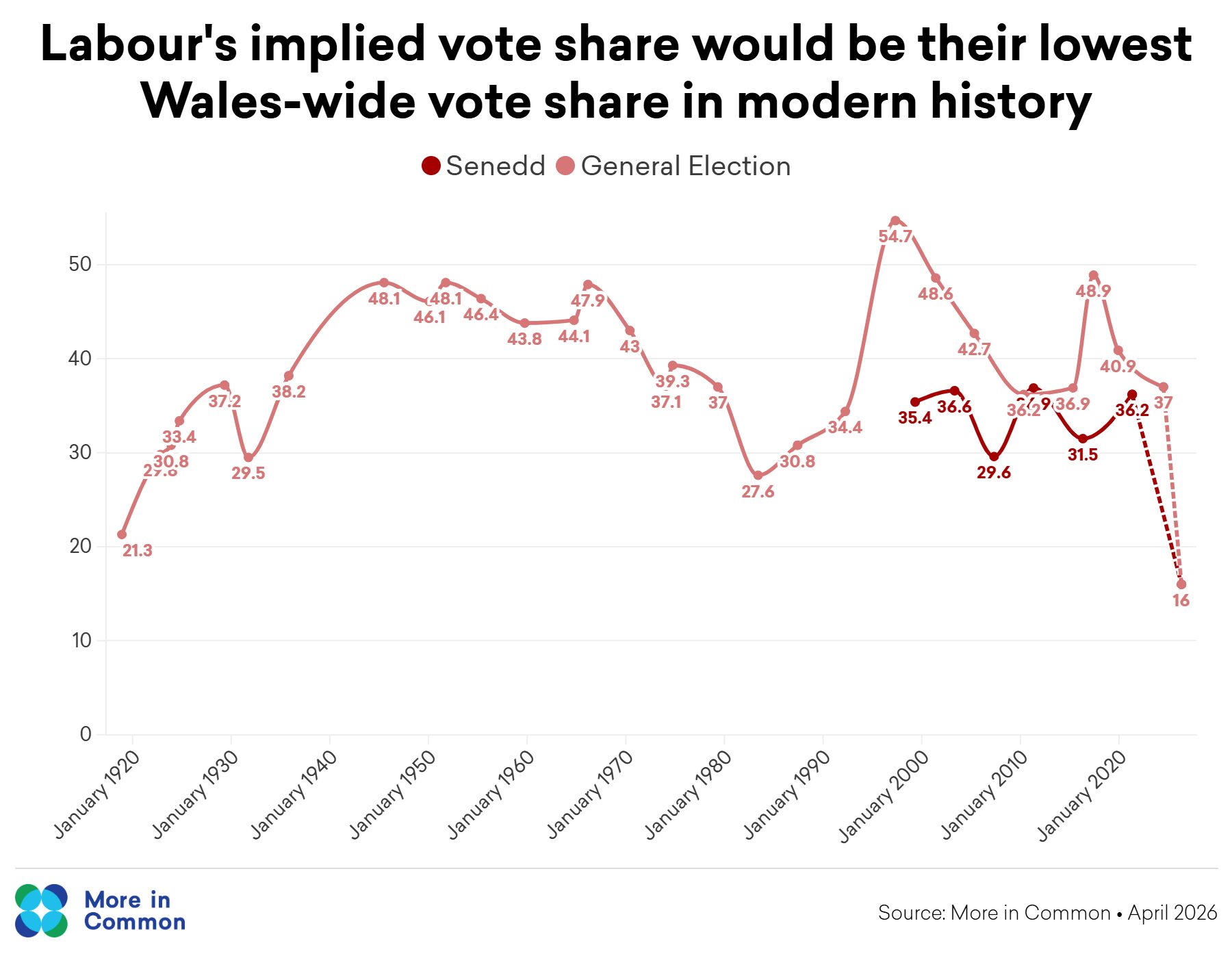
This would be Labour’s worst result in Wales since the extension of the franchise: Since Labour first became a political force in Wales in the 1920s, the party’s support has never dropped below 20 per cent in a General or devolved election. More in Common’s model has Labour falling to just 16 per cent - less than half of what the party earned as recently as the 2021 Senedd election (36 per cent).

Labour Vote Share In Wales 1918 Present@2X (1)

Conservatives pushed into fourth place, as Reform overtake them as the party of the Welsh right

The Conservatives are set to win 9 seats and be pushed into fourth place. Their strongest showings are in Sir Fynwy Torfaen (19 per cent) and Clwyd (19 per cent), but even in these areas of historic strength, they are outpolled by Reform. 

Since 2021, the Conservatives’ support has halved in Wales. From a vote share of 25 per cent in the 2021 regional list vote, they have now fallen to just 12 per cent. This would represent the party’s lowest vote share in any Senedd election.

Greens set to enter the Senedd for the first time, winning 5 seats

The Green Party has never held a seat in the Senedd. This model estimates they will win 5 seats, with their support concentrated in urban and suburban areas. Their strongest constituency-level performances are in the two Cardiff seats, Caerdydd Penarth (19 per cent) and Caerdydd Ffynnon Taf (15 per cent).

The Greens are set to double their previous high vote share. In the 2021 Senedd Election, the Greens won around 4.4 per cent of the regional list vote - their highest ever; this model sees them earning 9 per cent of the vote.

New election system leaves 1 in 6 seats incredibly marginal

The d’Hondt formula (the formula used to allocate seats based on votes) means that seats allocated later in the process are more sensitive to small changes in the vote, especially the fifth and 6th seat in each constituency, many of which could be decided by less than 2.5 per cent of the vote.

This means that one in six seats in Wales could be decided by razor-thin margins, with as little as 0.06 per cent deciding the sixth seat in one constituency.

These marginal seats could make or break Plaid Cymru’s presence in the Senedd: If the marginal 6th seats all tip Plaid’s way they could end up with as many as 40 seats in the Senedd - easily surpassing Reform - but a swing in the opposite election could force them down to just 31.

Luke Tryl, Executive Director of More in Common UK, said:

"With less than a week to go, the race has tightened. Plaid Cymru now leads on vote share, but in terms of seats it all looks set to come down to the 6th seat in each constituency which will likely be decided by handfuls of votes.

As we saw ahead of the Caerphilly by-election, Labour is being squeezed in the final days as voters rally behind Plaid Cymru as the progressive alternative to Reform. The party looks set to fall into the teens - Labour’s worst result in Wales since the extension of the franchise. After nearly three decades leading the Senedd, Labour could fail to top the poll in any constituency and be pushed into third place.

For Reform, this would represent an extraordinary breakthrough - going from barely contesting the last Senedd election to being in contention for the highest number of seats. 

Plaid Cymru is carrying the change mantle, and seems to be gaining momentum as we reach the finish line. But even Rhun ap Iorwerth will not be celebrating yet: the outcome is likely to require complex coalition or confidence and supply negotiations.

We head into the final days on a knife edge, and no clear picture of what the next Welsh government will look like.”