
Key findings:
- SNP on track for 60 MSPs – 5 seats short of a majority. This marks a decline since 2021, but a slight recovery since More in Common’s latest MRP in early April.
- Labour facing significant losses, now projected to win no constituency seats and falling to 13 MSPs overall, down from 17 in More in Common’s first model.
- SNP would need Green support to govern. Together, SNP and Greens could reach 70 seats – surpassing the 65-seat threshold needed for a majority in Holyrood.
- Reform UK now in clear second place, winning their first two constituency seats and picking up a seat in every regional list, leaving them on 22 seats overall – 9 more than Labour.
- Undecided voters could be set to decide the election. The SNP is within five percentage points of victory in five constituencies – winning all of them would put the party over the 65-seat threshold for a majority. But losing the ten marginal they currently hold by fewer than five points would put a nationalist majority out of reach. With 18 per cent of voters still undecided, the outcome may hinge on what these uncertain voters choose.
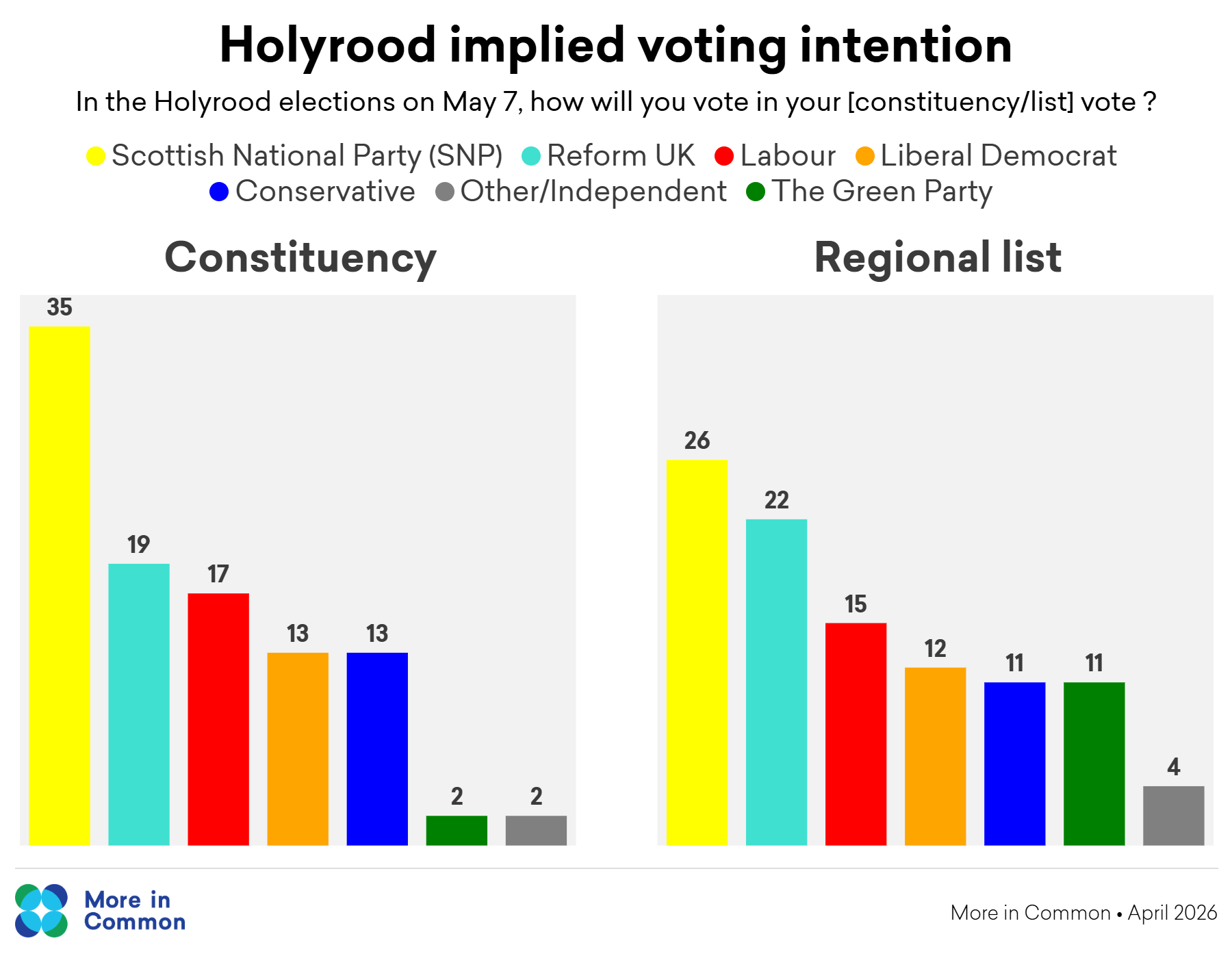
| Constituency seats | List seats | Total seats | Change in number of seats from 2021 | Change vs first model | Implied voting intention (constituency) | Implied voting intention (region) | |
| SNP | 60 | 0 | 60 | -4 | +4 | 35 | 26 |
| Reform UK | 2 | 20 | 22 | +22 | — | 19 | 22 |
| Labour | 0 | 13 | 13 | -9 | -4 | 17 | 15 |
| Conservatives | 3 | 9 | 12 | -19 | — | 13 | 11 |
| Liberal Democrats | 7 | 5 | 12 | +8 | -2 | 13 | 12 |
| Greens | 1 | 9 | 10 | +2 | +2 | 2 | 11 |
SNP recovers ground but majority remains out of reach
The latest model projects the SNP will win 60 of 129 seats, an increase of four seats since More in Common’s first model, but still five short of the 65 needed for a majority and down four on their 2021 result.
The SNP still dominates the constituency map, with their support highest in central Scotland strongholds: Glasgow Central, Dundee City West, and Argyll and Bute all return SNP members with over 43 per cent of the vote.
The SNP have flipped five seats since More in Common’s first projection in early April – at the expense of Labour and the Conservatives: Dumbarton and Edinburgh Southern from Labour, Edinburgh Central from Labour (where the Greens have also fallen back), Eastwood from the Conservatives, Galloway and West Dumfries from the Conservatives, and Skye, Lochaber and Badenoch from the Liberal Democrats.
Yet while the SNP have made gains since More in Common’s last MRP, some of their gains in the Scottish Borders have flipped back and remain marginal: Dumfriesshire and Ettrick, Roxburgh and Berwickshire have both flipped back to the Conservatives. All of the Scottish borders constituencies are now SNP-Conservative marginals decided by less than 3 percentage points.
The SNP’s victory is fuelled less by surging support than by fragmentation in the unionist vote. In fact, this result would represent the SNP’s lowest vote share in nearly two decades: their lowest constituency vote share since 2007, and lowest regional vote share since 2003.
Fragmentation and first-past-the-post are fuelling the SNP: Their high seats share comes from the number of high number first-past-the-post constituency seats in Holyrood, and their comparatively more consolidated support in a fragmented party system.
Reform shoots into a clear second place
Reform UK’s Scottish breakthrough remains the defining story of this election. The party is projected to win 22 seats in total – 2 constituencies and 20 list seats – becoming the second largest party in Holyrood.
Reform’s lead over Labour has grown significantly in recent weeks. Since More in Common’s last projection in early April, Reform’s lead over Labour has grown from 5 seats to 9 seats.
The party polls above 25 per cent in constituencies across the North East and parts of the central belt, and is projected to win in Banffshire and Buchan Coast and Ayr.
However one note of caution is this polling was conducted before the final STV debate and Malcolm Offord’s intervention on his personal wealth.
Labour set for its worst Scottish result since devolution
Labour is falling backwards: this model suggests the party could end up with just 13 MSPs. This is a decline of 9 seats since the 2021 election, and marks Labour’s lowest ever number of seats since the formation of the Scottish Parliament in 1999.
Labour’s position has deteriorated since More in Common’s last model, down from 17 earlier this month.
Labour is projected to win no constituency seats at all, leaving the party relying entirely on the regional list for its parliamentary presence. Scotland’s once-dominant party would be pushed into third place, just one seat ahead of the Conservatives and Liberal Democrats.
Labour could lose Dumbarton for the first time: Dumbarton is the only constituency in the Scottish Parliament to have voted Labour in every election since devolution. This model projects that the SNP would take the seat, with a margin of 5 percentage points over Labour.
Greens growing in Scotland
As the race reaches its final days, the Green Party looks set to make gains. The Scottish Greens win 10 seats in this updated model – up two on their 2021 result. Their one constituency win comes in Glasgow Kelvin and Maryhill. But it is on the regional list where they have grown: nine list seats, up from six in More in Common’s earlier model. The Greens are also close behind the SNP in two more constituencies: in Edinburgh North and Neith, they trail by just two points, and in Glasgow Southside they trail by 5 points.
Greens set to become Scottish kingmakers: an SNP-Green coalition would reach 70 seats – five clear of a majority – giving the Greens meaningful leverage over any prospective deal.
Conservatives in retreat
Conservatives are set to lose nearly two-thirds of their MSPs: the party that was second in Scotland just four years ago is estimates to collapse from 31 to 12 MSPs. Under this model, they would win three constituency seats and a further nine from the regional list. If the party returns only 12 MSPs it would be the Conservatives’ worst ever Holyrood result.
Squeeze from Reform could cost the Conservatives two of their constituencies: The Conservatives are projected to narrowly lose Eastwood and Galloway and West Dumfries to the SNP – with Reform UK earning more than 20 per cent in both seats and splitting the right leaning unionist vote.
Liberal Democrat resurgence
The Liberal Democrats are on track to win 12 seats – 7 constituencies and 5 list seats – more than trebling their presence in Holyrood compared to 2021, though down slightly from 14 in More in Common’s earlier model. They hold their seats across their heartlands in the north of Scotland, with Shetland, Fife North East, Orkney, and make gains in Edinburgh Northern, Strathkelvin and Bearsden, and Caithness, Sutherland and Ross, and come close to victory in Skye, Lochaber and Badenoch.
All to play for – and marginal gains could win the SNP a majority
The model finds a highly competitive race: 15 of 73 constituencies are decided by margins of under five percentage points, with nine of those under three points.
Marginal seats could win the SNP a majority: Alongside the 60 seats they are projected to win, the SNP are within 5 percentage points of victory in five constituencies. Winning these seats would bring the party to 65 seats – enough to govern Scotland as a majority government.
But the SNP’s position is precarious: there are 10 constituencies that the SNP wins with a margin of less than 5 percentage points. Losing these seats could make even a coalition with the Green Party unfeasible.
The tightest race in Scotland is Bathgate, where the SNP lead Reform UK by less than one percentage point. Ettrick, Roxburgh and Berwickshire, Banffshire and Buchan Coast, and Dumfriesshire are all decided by margins of under 1.5 points. Edinburgh North Eastern and Leith remains a knife-edge contest at under two points.
Reform UK are within striking distance in three constituencies beyond their two projected wins, polling within five points of the SNP in Bathgate, Cunninghame South and Aberdeenshire East.
Days from polling day, one in five Scottish voters are still undecided
With less than a week until the election, More in Common polling found that nearly one in five Scots (18 per cent) said that they were still undecided about who they were planning to vote for.
In focus groups, many describe this election as a highly difficult decision – some saying they will “decide on the day”.
In a race with many highly marginal constituencies, these uncertain voters could have an outsized impact, potentially helping determine whether the SNP earn a majority or are reduced to their lowest seat count in years.
Luke Tryl, UK Director at More in Common, said:
“With days to go until Scots head to the polls, the SNP look set to remain the dominant force in Holyrood, but this is a victory built on the collapse of other parties rather than a surge in their own support.
Our focus groups across Scotland find an electorate deeply uninspired by the choices before them, and the attitude of many we have spoken to could be best described as “meh”, which will see the SNP limp over the finish line with their lowest vote share in decades.
Labour’s position looks to be deteriorating as the election approaches. The party that once dominated Scottish politics is now projected to win no constituency seats at all. This projection suggests Labour could be facing their worst Scottish defeat since devolution. Even where Labour is the tactical choice to stop the SNP Unionists seem unwilling to rally round Anas Sarwar’s Party.
One of the defining stories of this election is Reform. Four years ago they barely existed in Scottish politics – and for a long time it was assumed Nigel Farage’s parties would not be able to break through North of the border. Now, they are on course to be the second largest party in Holyrood, overtaking Labour and the Conservatives, winning constituencies and picking up seats in every regional list.”